


Planning to sell your tutoring business, pass it down, or bring in a new partner? That’s succession planning. It’s the roadmap for transitioning your business to someone else, ensuring it not only survives but thrives without you. A solid plan can increase your center’s valuation by 15-25%.
The hard truth? Most tutoring centers are completely unprepared for this. The business is built entirely around the owner’s manual effort, making it incredibly difficult to hand over to someone new.
Why Most Tutoring Centers Are So Hard to Sell
The private tutoring market is growing, yet a shocking number of owners have no real plan to exit. The problem is almost always the same: the business runs on the owner's personal relationships and endless manual work, like juggling Google Calendar for scheduling and QuickBooks for billing.

When a potential buyer looks at your center, they aren't just buying your current roster of students. They're buying a future stream of income, an engine that runs itself. If that engine depends on you personally knowing every family's billing quirks or building schedules in a spreadsheet, its value plummets.
The Owner-Dependent Trap
Many successful tutoring centers are victims of their own success. The founder's passion is what made the business work, but that direct involvement becomes a massive liability during a sale. When you spend over 10 hours a week on manual admin, you’re not building an asset; you’re just creating a demanding job for yourself.
Consider these common scenarios:
- Scheduling Chaos: You are the only one who knows which tutors are qualified for AP Physics or which rooms are free on Tuesday afternoons.
- Billing Nightmares: You create invoices by hand, track payments in a notebook, and the cancellation policy lives only in your head.
- Client Relationships: Parents call you directly for everything, from booking a trial session to disputing a charge.
When you leave, all this operational knowledge walks out the door. A new buyer is left with chaos and a business worth far less than they paid. Building a Smart Business Exit Strategy means untangling yourself from these daily tasks to secure your center’s future and maximize its value.
A business that can't run without you isn't a business; it's a job. A sellable tutoring center is built on systems, not on the heroic daily efforts of its founder. We built Tutorbase as school owners who understand this chaos firsthand.
This isn't just a hunch. A staggering 70% of global family business leaders, including many in education, admit they have no formal succession plan. This is a huge risk, especially as the market grows. Private tuition for 11-16 year-olds in England and Wales jumped from 20% in 2009 to 27% in 2019, showing a growing demand for professionally run operations.
From Manual Mayhem to Sellable Systems
The secret to making your tutoring center attractive to a buyer is to systematize your operations long before you think about selling. Every manual task you perform is a red flag to an investor. If your business runs on a patchwork of tools, a new owner sees a steep learning curve and a high risk of failure.
This quick self-assessment helps you see where you stand. Are you building a sellable asset, or just a really demanding job?
Succession Planning Readiness Checklist for Tutoring Centers
| Area of Operation | Prepared (System-Driven) | At-Risk (Owner-Dependent) | How Tutorbase Helps |
|---|---|---|---|
| Scheduling | Central calendar with real-time availability, qualifications, and conflict detection. | You manually coordinate schedules via email and spreadsheets, causing double-bookings. | Tutorbase’s Find Slot tool prevents conflicts, cutting booking time from 10+ minutes to under two. |
| Billing & Payments | Automated invoicing from attendance data and a parent portal for online payments. | You create invoices by hand, chase late payments, and track cash payments manually. | Tutorbase automatically generates invoices from lesson attendance and manages prepaid credit balances. |
| Client Communication | Centralized notes, automated reminders, and a parent portal for progress updates. | You are the main point of contact; key student information is scattered or non-existent. | Automated reminders cut no-shows. Lesson notes are logged centrally and can be shared with parents. |
| Tutor Management | Tutors have logins to view schedules, manage lessons, and track hours for payroll. | You manually send schedules and calculate payroll from messy attendance sheets. | Each tutor gets a login. Tutorbase tracks hours and generates payroll reports automatically. |
| Reporting | Dashboards show revenue, capacity utilization, and teacher performance at a glance. | Financials are messy; key metrics require hours of manual calculation in Excel. | Real-time dashboards provide a clear view of business health, ready for any buyer’s due diligence. |
By documenting and automating these core workflows, you create a business that is transparent, predictable, and, most importantly, easy to manage for someone new. A new owner can immediately understand how to onboard a student or run payroll because the system dictates the process. This shift is the single most important factor in building a valuable asset. For a deeper dive, check our guide on tutoring center profitability.
How to Calculate the Real Value of Your Tutoring Business
When it's time to sell, figuring out what your tutoring business is really worth goes beyond a quick look at your annual revenue. The real value is in the health, predictability, and transferability of your operations. A serious buyer isn’t just buying your past success; they're buying your future cash flow and the systems that create it.
A center with documented, automated processes is a low-risk investment that will always command a higher price. We've seen it firsthand: a business with clean, verifiable data from a centralized management system can often fetch a 15-25% higher valuation than one run on fragmented tools.
Moving Beyond Simple Revenue Multiples
While it's common to hear about valuing a small business with a simple multiple of revenue, that approach is too blunt for a tutoring center. Buyers will dig much deeper into the quality of your earnings. This is where a couple of key metrics come into play.
- Seller's Discretionary Earnings (SDE): This is the total financial benefit a single full-time owner gets from the business. You start with your net profit and then add back your own salary, personal perks run through the business (like a car payment), and any unusual one-time costs.
- EBITDA (Earnings Before Interest, Taxes, Depreciation, and Amortization): This is more common for larger businesses. It shows the raw operational profitability of the company, stripping out accounting and financing decisions.
For the vast majority of tutoring centers, SDE is the number that matters most. It gives a potential buyer a crystal-clear picture of the money they can expect to pocket if they step into your shoes.
The True Drivers of Business Value
Financial metrics like SDE establish a baseline, but the final offer is shaped by the health of your day-to-day operations. This is where all your hard work on tutoring business succession planning really pays off. A system-driven business is fundamentally more valuable.
Let's look at two tutoring centers, both with $500,000 in annual revenue.
Center A: The Manual Operation The owner juggles Google Calendar for scheduling, QuickBooks for some billing, and a monster Excel sheet for payroll. Student packages are tracked by hand, and there's no real data on why students leave. A buyer sees 20+ hours of weekly admin headaches just to keep the lights on.
Center B: The Systemized Operation This owner uses a platform like Tutorbase. A potential buyer can log in and instantly verify the business's health:
- Recurring Revenue: They see exactly how many students are on prepaid packages or stable monthly subscriptions.
- Student Retention: Clear reports show a low churn rate of just 5% per semester.
- Capacity Utilization: Dashboards reveal that group classes are consistently 85% full, with obvious room for growth.
- Operational Efficiency: With automated billing, payroll, and scheduling, the business runs with just a few hours of admin work per week.
Center B will sell for a much higher multiple of its SDE than Center A. The buyer isn't just acquiring revenue; they're acquiring a stable, scalable asset with predictable income and ridiculously low operational drag.
A buyer will always pay a premium for predictability. Clean, verifiable data from a centralized management system builds immense buyer confidence and reduces their perceived risk.
How Operational Health Translates to Dollars
Every undocumented process or manual workflow is a risk a buyer has to price into their offer. Put yourself in their shoes for a minute.
If your billing is manual, they see the risk of missed payments and hours spent resolving disputes. A system like Tutorbase that automates invoicing directly from attendance records makes that risk disappear.
If scheduling relies on your personal knowledge, they see the risk of chaos and double-bookings the second you're gone. Software with built-in conflict detection makes the handover a non-issue.
By systemizing your business, you actively de-risk the purchase for the buyer. You’re proving that the center’s success is baked into its processes, not just your personal hustle. This is the most powerful way to maximize your final sale price.
Building an Operational Playbook for a Smooth Handover
A potential buyer isn't looking to purchase your job. They want to acquire an asset, a business that runs predictably, whether you’re there or not. This is where an operational playbook becomes the single most valuable tool in your succession planning. Think of it as the "how-to" manual for your tutoring center.
It’s proof that your success comes from repeatable, documented systems, not just your heroic efforts. When a buyer sees a clear playbook, their perceived risk plummets. The goal is to create a business that’s transparent and easy for a new owner to step into from day one.
What Goes Into a Tutoring Center Playbook
A solid playbook tames the day-to-day chaos of running a tutoring business. It needs to cover the entire lifecycle of your customer and staff interactions, leaving zero room for guesswork.
Your playbook should clearly define all the core processes:
- Student Onboarding: The step-by-step journey from a parent's inquiry to their first paid lesson.
- Scheduling and Rescheduling: Your exact rules for booking lessons, managing recurring sessions, and handling cancellations.
- Billing and Invoicing: The rhythm and rules for generating invoices, chasing payments, and managing overdue accounts.
- Tutor Payroll: How you track hours, calculate different pay rates (per-hour, revenue share), and settle payments.
- Parent Communication: Standard procedures for sending progress reports and resolving issues.
Trying to document all of this from scratch is overwhelming. This is why using a dedicated management system is such a smart move. A platform like Tutorbase for tutoring centers essentially builds this playbook for you.
How Technology Creates Your Playbook Automatically
Instead of writing down rules in a binder that gathers dust, a modern tutoring management platform codifies your operations. The system is the playbook, ensuring everyone follows the same processes, every single time. A new owner doesn’t need a long handover meeting; they can just look at the system's configuration.
This flow chart shows how systemizing your revenue and operations is the bridge to maximizing your final valuation.
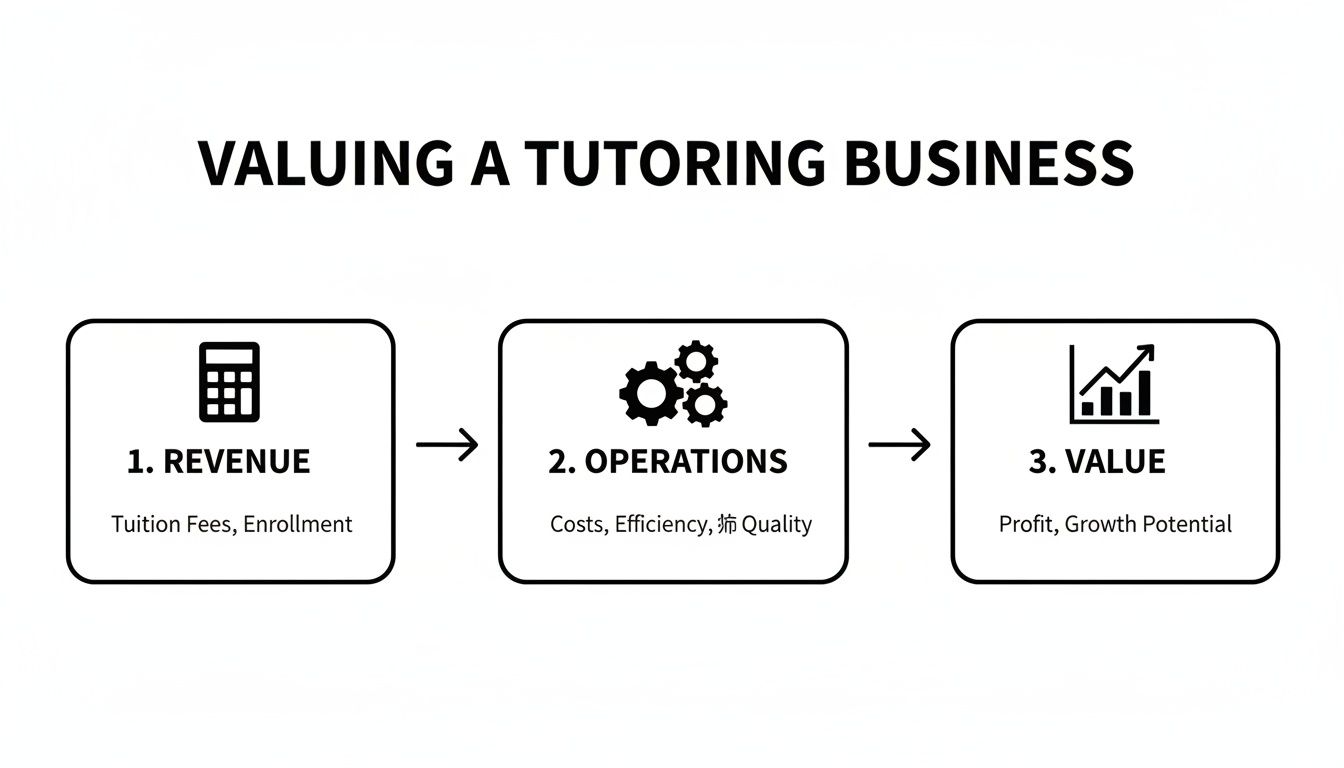
It’s clear that strong, documented operations are what turn your revenue into real, transferable market value.
For instance, within Tutorbase, specific features become your living documentation:
- Policy Packs: These don't just enable your pricing; they document it. A new owner can instantly see your exact rules for hourly rates, package deals, and cancellation fees.
- CRM Pipeline: Your sales process is visually mapped from "New Lead" to "Converted." This shows a buyer a predictable, repeatable system for generating new business.
- Automated Billing Workflows: The system’s settings for invoice timing (e.g., weekly, monthly, per-lesson) define your entire financial cycle for them.
A business with an operational playbook embedded in its management software proves that its cash flow is stable and transferable, removing uncertainty for a buyer.
Operational Playbook Before vs. After Systemization
The difference between a sellable, systemized business and a high-risk, owner-dependent one is night and day. Imagine a buyer doing their due diligence and looking at these two scenarios. The "After" state isn't just more efficient; it's a blueprint for success a new owner can trust immediately.
| Core Process | Manual 'Before' State (High Risk) | Systemized 'After' State (Low Risk) |
|---|---|---|
| Student Onboarding | You field calls, manually check spreadsheets, and email Word doc invoices. | A lead from your website populates the CRM, a trial is booked online, and the system converts them to a client. |
| Scheduling | Relies on your memory and a color-coded spreadsheet. Double-bookings are a weekly headache. | Tutorbase's 'Find Slot' feature prevents conflicts and finds valid teacher/room/time options in seconds. |
| Billing | You spend days reconciling attendance notes to create and send invoices one by one. | Invoices are auto-generated from attendance data. Parents pay online via a portal with prepaid credits. |
| Payroll | You manually calculate hours from sign-in sheets, trying to recall different pay rates from memory. | The system tracks teaching hours, applies the correct pay rates, and generates a payroll report in minutes. |
Building out this "After" state is the most critical step you can take to prepare your business for a successful and profitable exit. It transforms your daily grind into a valuable, sellable asset.
Preparing Your Team and Students for the Transition
A successful handover depends on people, not just processes. Once you’ve documented your operational playbook, the real work begins: preparing your staff, tutors, and clients for the change. A clumsy transition can lead to staff departures and student churn, eroding the very value you've worked so hard to build.

This is all about careful communication. You need a clear strategy for who to tell, what to say, and when to say it. The goal is simple: create a sense of stability and reassurance for everyone involved.
Communicating with Your Staff and Tutors
Your team is the heart of your business, and their confidence in the new leadership is non-negotiable. Announcing a sale too early can spark anxiety, so timing and transparency are everything.
Start by identifying the key players who are essential for a smooth handover. This might be your lead tutor or an operations manager. Bring them into the loop confidentially first; their support will be vital when you announce the news more broadly.
When it's time to tell the rest of the team, your message should focus on continuity.
- Highlight the Positives: Explain that the new owner was chosen because they share the center’s values and are committed to its mission.
- Clarify Their Roles: Reassure them about their job security. Uncertainty is the biggest driver of resignations, so make it clear their roles are safe.
- Introduce the New Owner: Set up a meeting where the new owner can share their vision and answer questions directly. This personal connection makes a world of difference.
A well-managed internal transition makes the new owner’s job infinitely easier. When your team feels respected and informed, they're far more likely to embrace the change.
Managing Student and Parent Expectations
For parents, any change in ownership can feel unsettling. Their only real concern is whether their child will continue to receive the same high-quality education. Your communication needs to be proactive, clear, and reassuring.
It’s often best to inform them after the deal is legally finalized but before any public announcement. This gives them a sense of being valued insiders and prevents them from hearing the news secondhand.
A new owner inheriting a business with clear, centralized data can immediately demonstrate competence. By pulling up a student's complete history—attendance, progress notes, and payment status—they can have an informed conversation with a parent from day one, building trust instantly.
This is where a system like Tutorbase becomes your secret weapon for a smooth handover. A new owner isn’t walking in blind. They have immediate access to everything they need:
- Student History: Complete records of every lesson, notes from tutors, and past invoices.
- Teacher Profiles: Detailed information on each tutor's qualifications, availability, and specific pay rates.
- Operational Data: A clear view of class schedules, room bookings, and overall capacity.
This level of organized information prevents the kind of disruption that scares clients away. The new owner can confidently answer questions and manage the center from day one, ensuring parents see no dip in service quality. They see a professional handover, not a chaotic scramble.
Navigating the Legal and Financial Side of the Sale
Let's talk about the part that can feel the most intimidating: the maze of legal and financial steps involved in selling your business. This is where your hard work preparing the business turns into a real transaction. A smooth sale comes down to having the right experts in your corner and your documents in perfect order.
First, you should not do this alone. Your first move is to build a professional transition team. These are the people who will guide you through negotiations and due diligence, making sure your interests are protected every step of the way.
Your core team should include:
- A Business Broker: These specialists know how to market a business like yours, find qualified buyers, and help you negotiate the best price.
- An Accountant: You need a pro who can help you prepare clean, accurate financial statements that will stand up to intense scrutiny.
- A Lawyer: Find one who specializes in small business sales. They will be responsible for drafting and reviewing every legal document, from the initial NDA to the final purchase agreement.
Getting Your Key Documents in Order
With your team in place, it's time to gather the paperwork that any serious buyer will demand. This is where all your previous organizational efforts truly pay off. A buyer isn't just buying your brand; they're buying proof of a healthy, stable operation. That proof is in your records.
Having organized data from a system that tracks every lesson, payment, and invoice can dramatically speed up the due diligence process. More importantly, it builds immense confidence in a buyer. Clean records signal a well-run business.
Here are the key documents you’ll need to have ready:
- Financial Statements: Have at least three years of profit and loss statements, balance sheets, and cash flow statements ready.
- Tax Returns: This includes both business and personal tax returns for that same three-year period.
- Employee and Contractor Agreements: Clear contracts outlining roles, pay structures, and responsibilities are non-negotiable. Our guide on a tutoring contract template can be a huge help.
- Client Agreements and Packages: You need to show documentation of your service offerings, pricing, and active client contracts.
The statistics here are sobering. While 74% of small-business owners plan to sell their company to fund retirement, a simple lack of preparation often sinks the ship. Some studies show that as many as 70% of small businesses listed for sale never find a buyer, with closing rates dipping to a mere 5.56% in recent years.
Understanding the Structure of the Deal
Not all sales are created equal. Your lawyer will be invaluable here, helping you navigate the two most common types of deals. Each one has very different tax and liability implications for you and the buyer.
- Asset Sale: In this scenario, the buyer purchases specific assets of your business, like your client list, brand name, and curriculum. You, the original owner, keep the legal business entity and any liabilities not explicitly transferred. Buyers often prefer this.
- Stock Sale: Here, the buyer purchases your shares in the company, acquiring the entire legal entity. That includes all of its assets and, crucially, all of its liabilities. This can be a simpler transaction but often carries more risk for the buyer.
Before a single sensitive document changes hands, your lawyer must insist on a Non-Disclosure Agreement (NDA). This is a legally binding contract that stops a potential buyer from spilling your confidential business secrets.
A buyer will want to examine every single aspect of your operations. Using a comprehensive due diligence checklist is essential to uncover potential risks and opportunities. Being prepared is your single best negotiating tool.
FAQ: Your Top Succession Planning Questions Answered
Even with a clear roadmap, specific questions will inevitably pop up. We've heard a lot of them from center owners over the years, so let's tackle the most common ones.
How Long Does It Really Take to Sell a Tutoring Business?
Realistically, you should expect the process to take anywhere from six to twelve months from the day you list your business to closing the deal. This timeline assumes you have already organized your financials and operations. A system like Tutorbase can shave weeks, or even months, off the due diligence phase because you can pull clean revenue reports instantly.
What if I Don’t Have a Successor Lined Up?
You're not alone. The good news is that you don't need a hand-picked successor. Your goal should be to build a business that an external buyer can step into and run successfully from day one. Make your center a turnkey operation where scheduling, billing, and payroll are so systematized that they practically run themselves.
When Should I Tell My Staff I’m Planning to Sell?
Timing is everything. Announcing your plans too early can breed uncertainty. The consensus from business brokers is to wait until the deal is nearly certain, ideally once you have a signed letter of intent from a serious buyer. Start by bringing one or two key managers into the fold first, then share the news with the broader team, framing it around continuity and job security.
Can I Sell My Business if It Isn’t Profitable?
It’s tough, but not impossible. An unprofitable business can still attract a buyer if it has other strong assets like a recognizable brand, a large client list, or a fantastic physical location. However, the smarter move is to focus on getting into the black before you sell. Take six months to drill down into your numbers and fix inefficiencies to boost your final sale price.
Ready to build a more valuable, sellable tutoring business? Tutorbase provides the operational playbook you need to automate scheduling, billing, and payroll, turning your center into a streamlined asset. See how you can reduce admin time by 60% and prepare for a successful future. Start your free trial at tutorbase.com/register.


