


A curriculum map is your tutoring center's strategic GPS. It's a high-level visual plan that outlines what you teach, in what order, using which materials, and how you measure student success. This roadmap transforms individual tutor efforts into a cohesive, quality-controlled educational program.
What is a Curriculum Map and Why Does It Matter?

A curriculum map is the architectural blueprint for your educational programs. For a tutoring business, it’s what moves you beyond relying on individual tutor heroics and establishes a consistent, scalable standard of quality. It provides a clear, confident answer when a parent asks, “So, what will my child actually learn over the next six months?”
This structured approach is no longer just for big schools. While over 90% of schools use digital tools, more than 40% of educators admit they lack visibility into how learning standards are being met across classrooms. Curriculum mapping directly solves this disconnect by creating a single, unified plan for everyone to follow.
The Strategic Value of Mapping for Tutoring Centers
A curriculum map is more than a syllabus. It’s an operational tool that aligns your entire business, from the promises you make in your marketing to what actually happens in a session. For owners of tutoring centers and language schools, this alignment prevents inconsistent student experiences and administrative chaos.
A curriculum map ensures that a student learning 'Grade 8 Math' with Tutor A in one branch receives the same core instruction and meets the same learning objectives as a student with Tutor B in another branch. This consistency is the foundation of a scalable, trustworthy brand.
Without a map, quality can vary wildly. One tutor might focus heavily on theory while another prioritizes practical exercises. This creates an inconsistent student experience and makes it almost impossible to track real progress systematically, which can lead to lower student retention and damage your center’s reputation.
A curriculum map breaks down what needs to be taught into clear, manageable components. This table shows the key pieces of information you need to build your own.
Quick Guide to Curriculum Map Components
| Component | Description | Example for a Tutoring Center |
|---|---|---|
| Units/Modules | Major topics or themes covered over a set period (e.g., a term). | Algebra I: Foundations |
| Learning Objectives | Specific, measurable skills students should master in each unit. | "Students will be able to solve linear equations with one variable." |
| Timeline | The sequence and duration for each unit (e.g., Week 1, Week 2-3). | Weeks 1-2: Solving one-step and two-step equations. |
| Key Activities | Core exercises, projects, or discussions used to teach the concepts. | Whiteboard practice, worksheet completion, real-world word problems. |
| Resources & Materials | Textbooks, software, worksheets, or online tools required. | Khan Academy videos, IXL Math exercises, center-provided worksheets. |
| Assessments | How you measure student understanding (quizzes, tests, projects). | Weekly 5-question quiz; end-of-unit review test. |
By organizing your curriculum this way, you create a clear and repeatable process that any tutor on your team can understand and follow.
How Curriculum Maps Build Trust and Ensure Quality
A well-defined curriculum map brings clarity to everyone. Tutors know exactly what to teach and when. Students follow a logical learning path, and parents see a clear return on their investment. This structure also simplifies communication during parent-teacher meetings, much like an essential parent teacher conference template guide provides talking points.
Ultimately, curriculum maps deliver three critical benefits for your tutoring business:
- Educational Consistency: Guarantees a standard level of quality across all tutors, subjects, and even different locations.
- Clear Progression: Shows students and parents a clear journey from their current level to their learning goal, preventing confusion.
- Operational Efficiency: Simplifies onboarding for new tutors and cuts down the admin time spent planning lessons from scratch, reducing overhead.
The Core Components of an Effective Curriculum Map

To build a curriculum map that works, you need five core components. Think of these as the essential ingredients in a recipe, each playing a specific role in creating a clear, logical, and repeatable learning path for your students. A curriculum map is not just an academic document; it’s a practical business tool that defines your educational product.
1. Learning Objectives (The "What")
Learning objectives are the foundation of your map. These are clear, specific statements defining what a student should know or be able to do by the end of a unit or level. They transform vague goals into measurable targets that prove your teaching works.
Weak Objective: "Student will get better at Spanish."
Strong Objective: "Student will be able to ask and answer basic questions about their daily routine using present tense verbs." (Spanish A1 Level)
Weak Objective: "Student will improve in SAT Math."
Strong Objective: "Student will be able to solve linear equations and systems of linear equations with at least 90% accuracy." (SAT Math Prep)
2. Content and Topics (The "How")
This part of the map outlines the specific subject matter you'll teach to meet your learning objectives. It’s the core of your curriculum, sequenced logically to build knowledge. This ensures every tutor covers the necessary material in the right order.
For example, a "Grade 7 English" curriculum might sequence its topics like this:
- Unit 1 (Weeks 1-4): Narrative Writing & Short Stories
- Unit 2 (Weeks 5-8): Introduction to Literary Analysis
- Unit 3 (Weeks 9-12): Poetry & Figurative Language
3. Skills (The "Doing")
While content is about knowledge, skills are about application. This component specifies the practical abilities students will gain. It answers the critical question: “What can the student actually do with what they know?”
A great curriculum map makes a sharp distinction between knowing concepts and applying skills. A student may know the formula for the area of a circle, but the skill is being able to use that formula to solve a real-world problem.
For a DELF B1 French exam prep course, the skills section would list things like:
- Writing: Composing a formal email to request information.
- Speaking: Describing a past event and expressing a personal opinion.
- Reading: Understanding the main points of a newspaper article.
4. Assessments (The "Proof")
Assessments measure whether a student has mastered the learning objectives. These checkpoints prove your teaching is effective. A solid map includes a mix of formal and informal assessments.
- Formative Assessments: These are low-stakes checks for understanding, such as weekly quizzes, quick whiteboard exercises, or exit tickets at the end of a session.
- Summative Assessments: These are bigger tests of mastery, like end-of-unit exams, final projects, or full-length mock exams that evaluate everything covered.
5. Resources and Materials (The "Tools")
This component lists the specific tools your tutors will use to deliver each lesson. Centralizing this information is key to ensuring consistency and quality. It stops tutors from wasting time hunting for materials or using inconsistent ones.
Resources can include textbooks, worksheets, online software (like IXL or Khan Academy), practice tests, or specific videos. By defining these five components, you create a complete and actionable curriculum map.
How Does Curriculum Mapping Solve Your Biggest Headaches?
Knowing what a curriculum map is one thing; seeing how it solves your most frustrating daily problems is another. For most tutoring center owners, the daily grind feels like constant firefighting, from inconsistent teaching quality to struggling to show parents their investment is paying off. A curriculum map is your strategic solution.
It directly addresses the inconsistency problem. When a parent signs their child up for "Grade 8 Math," they are buying a result. A map ensures that whether their tutor is Sarah or Michael, at your downtown location or the suburban one, the core learning goals are the same.
That consistency has a direct impact on your bottom line. By delivering a predictable and transparent educational path, you build trust with parents. This is the secret behind results like a 42% increase in monthly renewals, turning your teaching framework into a powerful retention tool.
Creating Consistency and Boosting Teacher Effectiveness
A major hurdle for a growing tutoring business is keeping quality high as you hire more tutors. How do you ensure the new hire delivers the same value as your star performer? A curriculum map acts as a clear playbook for your entire staff.
The map removes guesswork by defining what to teach and in what order. This frees up tutors to focus on how to teach best, rather than scrambling to decide what to teach next. This structured approach gets results. Research on curriculum mapping found it directly led to higher student achievement, with one teacher noting it provides critical clarity: "You know what they've seen... what they have supposedly mastered, and at what level." You can read the full research on curriculum mapping effectiveness.
Making Student Progress Visible and Tangible
Without a map, tracking progress is vague and subjective. Tutors might say a student is "doing better," but they lack concrete data to back it up. This makes parent-teacher conversations feel weak and can erode a parent's confidence in your program.
A curriculum map translates your teaching process into a tangible journey with clear checkpoints. It lets you say, "Your child has mastered solving two-step equations and is now moving on to inequalities, right on schedule."
This structured tracking provides the hard evidence needed for meaningful progress reports and parent conferences. It is the backbone of a system that proves your value. You can learn more about how to effectively track student progress in our guide. By solving these core operational headaches, curriculum maps help you deliver on your promises every time, building a more stable and profitable tutoring business.
How to Build Your First Curriculum Map Step-by-Step
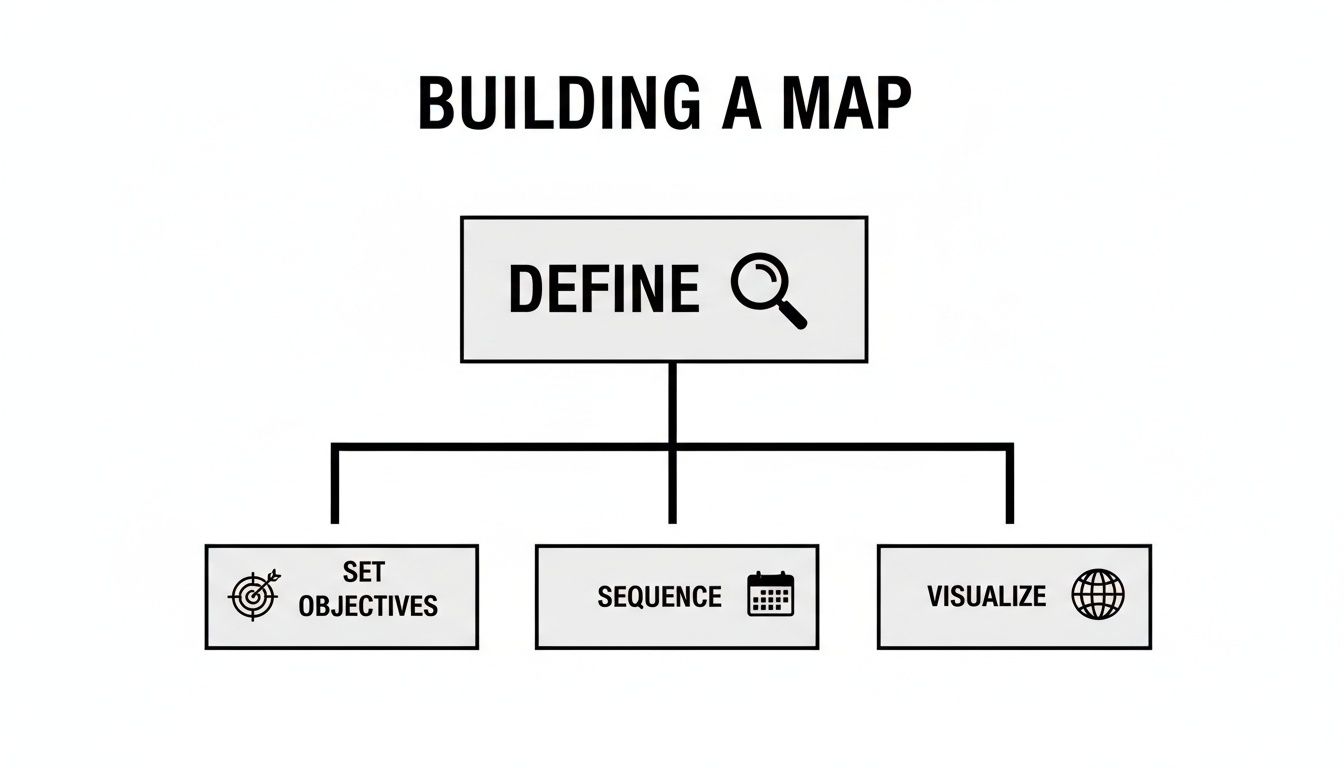
Creating a curriculum map from scratch can feel daunting, but it doesn't have to be complicated. The key is to break the project into smaller, manageable pieces. You are not trying to build a perfect, finished product on day one; you are drawing the first draft of a map to guide your tutors and students.
Step 1: Define Your Subjects and Levels
Before mapping a journey, you must know where it starts and ends. First, list every subject you teach: "Math," "English," "Spanish," "SAT Prep." Then, for each subject, break it down into the specific levels or grades you cover. This creates the basic skeleton for your curriculum.
- For K-12 Tutoring: Use grades like "Grade 7 Math," "Grade 8 Math," and so on.
- For Language Schools: Use a recognized framework like "Spanish A1," "Spanish A2," "Spanish B1."
- For Test Prep: Break it down by sections, such as "SAT Reading & Writing" and "SAT Math."
Step 2: Set Clear Learning Objectives
Once you have subjects and levels, give each one a purpose. A learning objective is a clear statement of what a student should be able to do by the end of a level or unit. This is the most critical part of the process.
A strong objective turns a vague promise like "get better at English" into a concrete goal like, "The student will be able to write a five-paragraph literary analysis essay with a clear thesis statement."
For each level you defined, aim for 3-5 core learning objectives. Focus on the major milestones that signal a student is ready to move on. For more guidance, explore how to create a tutoring curriculum framework in our full guide.
Step 3: Sequence Your Units and Lessons
Now you can arrange the topics and skills needed to meet your objectives in a logical order. Think of a subject like "Grade 9 Algebra" as a book; your units are the chapters. You would not have a student read Chapter 5 before Chapter 2.
Group your topics into broader units or modules. For "Grade 9 Algebra," your units might look like this:
- Unit 1 (Weeks 1-4): Foundations of Algebra & Linear Equations
- Unit 2 (Weeks 5-8): Inequalities and Systems of Equations
- Unit 3 (Weeks 9-12): Functions and Graphing
By assigning a rough timeline, you give tutors a pacing guide that keeps everyone on the same page.
Step 4: Align Assessments to Prove Mastery
How will you know if students are getting it? Your map needs checkpoints. For each unit, decide how you will measure whether a student has mastered the learning objectives. A good map uses a mix of assessment types.
- Formative Assessments: These are small, frequent check-ins like weekly quizzes, homework, or in-class activities to see if a student is on track.
- Summative Assessments: These are bigger evaluations at the end of a unit, such as a test or final project, that show what they’ve learned.
When your assessments tie directly to your learning objectives, you get concrete proof that your methods are working.
Step 5: Select Your Teaching Resources
The final step is to equip your tutors. Here, you'll list the specific materials they should use for each unit. This is a game-changer for quality control, ensuring every student receives the same high-quality instruction regardless of their tutor. It also saves your tutors countless hours.
Be specific. Instead of "worksheets," specify "Kuta Software Algebra 1 Worksheets." Other examples include:
- Textbooks (e.g., "Pearson Algebra 1, Chapters 3-4")
- Online platforms (e.g., "Khan Academy units on linear equations")
- In-house materials (e.g., "Our center's mock SAT Test #3")
Following these five steps will give you a solid curriculum map that brings consistency and professionalism to your tutoring business.
How to Bring Your Curriculum Map to Life With Software
A curriculum map on a spreadsheet is a good start, but it's a static plan. It's like having a blueprint for a house but no tools to build it. Inside tutoring management software, that blueprint becomes a dynamic, operational tool. This is where your educational strategy meets intelligent automation.
This is how you turn an academic plan into a bookable, billable, and scalable service. Software is what activates your curriculum map, turning its abstract steps into tangible functions that run your business daily.
From Map Components to Software Features
In a system like Tutorbase, the core components of your curriculum map translate directly into functional features. This connection makes the map powerful, as it stops being a theoretical guide and starts driving operations from scheduling to student placement.
- Subjects & Levels: Your map’s high-level structure (e.g., "Math," "Grade 8") becomes the filterable core of your system, organizing everything from teachers to students by academic focus.
- Services: This is where you package your curriculum into sellable offerings. A "Service" in Tutorbase defines the class itself, like "Grade 8 Math - Group Session," linking your curriculum to price, delivery mode, and capacity.
This direct translation means your educational plan is no longer separate from your business operations; they are one and the same.
How an Activated Curriculum Automates Scheduling
Once your curriculum is structured within the software, it powers automation that solves major administrative headaches. The data from your map, including subjects, levels, and teacher qualifications, becomes the engine for smart scheduling.
A software-activated curriculum map transforms student onboarding from a 10-minute manual puzzle into a 2-minute automated process. It programmatically finds the right teacher, room, and time, cutting admin work by over 60%.
For example, when a new student needs "Spanish A2," a feature like "Find Slot" instantly checks which teachers are qualified, cross-references their availability with open rooms, and shows you valid booking options in seconds. This eliminates the manual "calendar hunting" that leads to double-bookings. By exploring the Tutorbase features, you can see how each piece of the system supports your curriculum.
Mapping Your Curriculum in Tutorbase
Making your curriculum map operational is about connecting its theoretical parts to real, functional software features. This table shows exactly how Tutorbase turns your plan into a working system.
| Curriculum Map Element | Corresponding Tutorbase Feature | How It Works |
|---|---|---|
| Academic Structure | Subjects & Levels | Organize all classes, tutors, and students into a clear, filterable hierarchy (e.g., "English" > "GCSE"). |
| Courses & Offerings | Services | Define sellable offerings by linking a subject/level to price, capacity, and delivery mode (e.g., "GCSE English - Group"). |
| Teacher Qualifications | Tutor Profiles | Assign subjects and levels to each tutor so the system knows who is qualified to teach what. |
| Scheduling Logic | Find a Slot | The system uses tutor qualifications, availability, and room schedules to instantly find valid booking times. |
| Progress Tracking | Lesson Notes & Reporting | Tutors log progress against the curriculum after each session, creating a clear record of student achievement. |
Every decision in your curriculum map has a direct counterpart in the software, creating a seamless link between your educational promise and your daily operations. This ensures every student is placed correctly, every class aligns with your standards, and your admin team operates with speed and accuracy.
Why a Standardized Curriculum Is a Global Necessity
In a world where students connect with tutors globally, a curriculum map is essential for any serious educational business. It is especially critical if you serve a diverse or international student body. For centers preparing students for exams like IELTS, TOEFL, or DELF, consistency is everything.
A clear, standardized curriculum ensures every student gets the same high-quality learning experience, whether their tutor is in London or Lisbon. It creates a reliable framework that helps bridge educational gaps. In 2023, around 244 million children were out of school. For many, a solid curriculum is a powerful tool for delivering dependable results. You can learn more about global education disparities on Our World in Data.
How to Establish Your Center as a Leader
For any ambitious center director, a well-defined curriculum is your biggest competitive advantage. It signals to parents that you are committed to quality that goes beyond local standards. It shows your center runs on a proven, professional system, not just the inconsistent efforts of individual tutors.
A curriculum map shows parents you have a proven system for success. It builds trust by making the learning journey transparent and predictable, proving you are a serious educational institution, not just a casual tutoring service.
This commitment to a unified standard tells families you are reliable and professional. Whether a student is logging in from Hong Kong or New York, your curriculum map guarantees they receive the same foundational education. It is how you build a brand known for excellence, attracting students from all over the world. A standardized curriculum is your key to scaling quality, not just size.
FAQ: Your Top Questions About Curriculum Mapping
Here are answers to the most common questions tutoring center owners have about curriculum mapping.
How long does it take to create a curriculum map?
The initial build can take anywhere from a few days for one subject to a few weeks for a full K-12 program. The trick is to start small. Map out your most popular subject first, learn the process, and then expand. While there is an upfront time investment, the effort pays back tenfold in saved admin time and operational consistency.
Is curriculum mapping only for large tutoring centers?
No. In fact, it might be even more valuable for smaller businesses. Even a solo tutor benefits from a clear map, as it proves to parents you have a structured, repeatable program, not just a series of ad-hoc lessons. It helps you show tangible progress.
For smaller centers, a curriculum map isn't just a document; it's a blueprint for growth. It creates a scalable foundation that makes it dramatically easier to hire new tutors and expand your business without sacrificing educational quality.
Will a curriculum map restrict my tutors' creative freedom?
This is a common and important concern. A good map will not turn your tutors into robots. A curriculum map should provide a framework, not a rigid script. It defines what to teach (the learning objectives) and in what general order, but it leaves the how up to the tutor. This structure ensures consistency while giving tutors the freedom to use their unique teaching methods.
How often should I update my curriculum maps?
We recommend a full review once a year. This is the perfect time to incorporate tutor feedback, align with new educational standards, and add new resources. However, your maps should be living documents. You should make minor tweaks throughout the year as you see what’s working to keep them sharp and effective.
What is the difference between a curriculum and a curriculum map?
A curriculum is the total learning experience, including all content, resources, and assessments. A curriculum map is the visual plan or blueprint that organizes that curriculum over a timeline. The map provides the sequence and structure, while the curriculum is the "what" that fills in that structure.
Ready to stop guessing and start standardizing your educational quality? Tutorbase turns your curriculum map into an automated, operational tool that saves you time and drives student success. Start your free trial today.


