


When you're tutoring a first grader in reading, that first session is everything. It’s not about diving straight into intensive drills. It's about observation and connection. Your job is to figure out where the child is right now, and you can do that with a quick, informal assessment that feels more like a game than a test.
Your Starting Point for Tutoring a First Grader in Reading
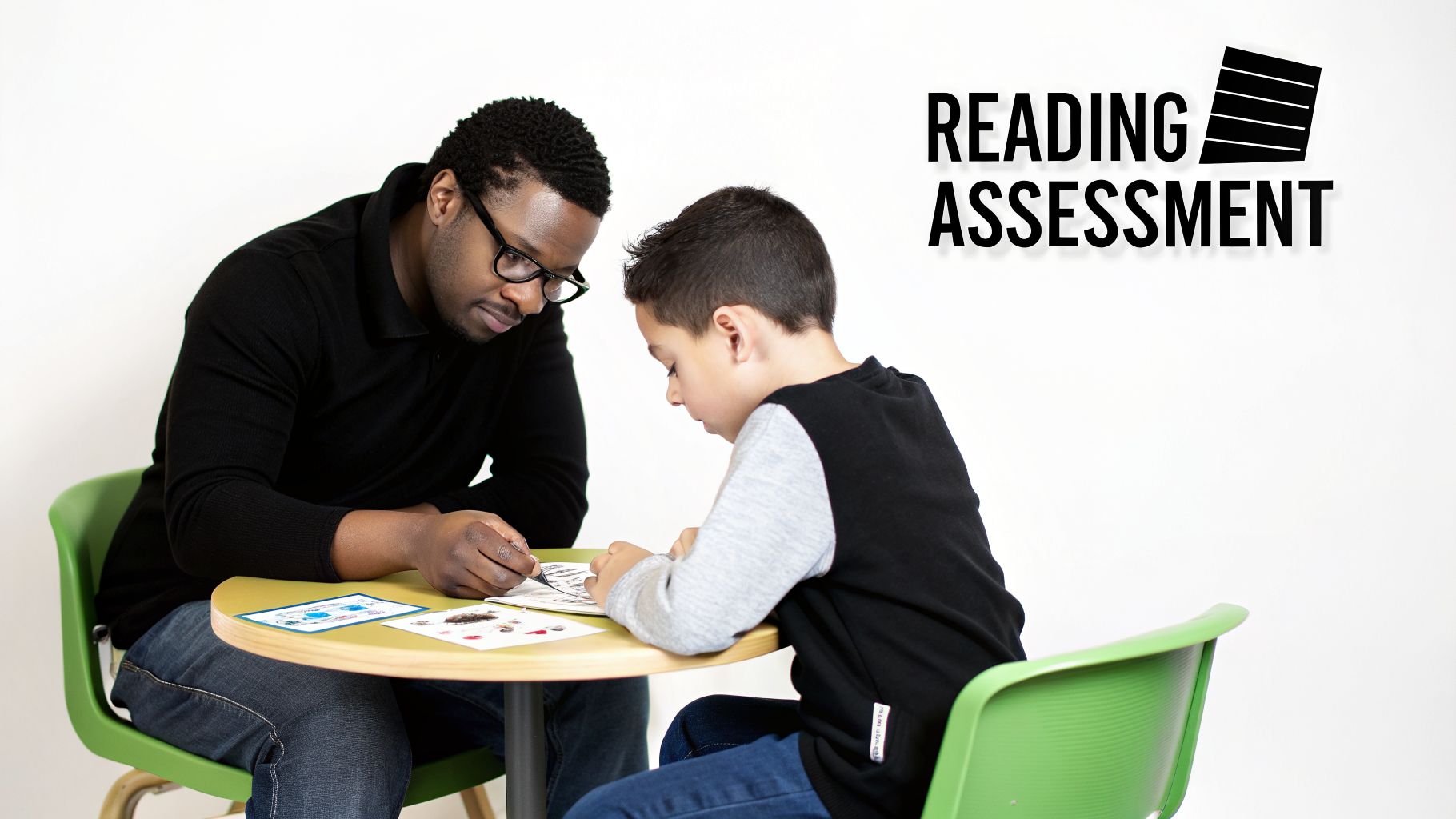
The main goal of your first meeting is to build a little trust and gather a lot of information in a low-pressure way. Forget about formal tests or anything that might cause anxiety. Instead, you'll use fun, game-like activities to see what they can do, identify their strengths, and pinpoint exactly which skills need some extra support. This is the key to creating a targeted lesson plan that builds confidence right from the start.
And that support is needed now more than ever. Research from The Hechinger Report highlighted a major challenge: in 2020, data showed that 40% of first graders were scoring 'well below grade level' in reading, a huge jump from 27% the year before. This meant schools had to provide intensive help to a much larger group of young students.
What to Assess in the First Session
Your assessment should feel like you're just playing together. You’re simply trying to get a baseline on a few core skills. This is the foundation of a good personalized learning approach, where you adapt your teaching to fit the student's specific needs, not the other way around.
During your initial session, use this simple checklist to get a quick snapshot of a first grader's reading skills. It's not about scoring them, but about observing what comes easily and what's still developing. This will help you create a tailored plan right from day one.
Quick Reading Skills Assessment Checklist for First Graders
| Skill Area | What to Look For | Simple Activity Example |
|---|---|---|
| Letter-Sound Recognition | Can the child match a letter to its most common sound? Do they hesitate or mix up similar-looking letters? | Use magnetic letters. "Can you find the letter that makes the /m/ sound?" or "What sound does this letter (point to 's') make?" |
| Phonemic Awareness | Can they hear and work with individual sounds in words? Blending, segmenting, and identifying rhymes. | "Let's play a rhyming game! Does 'cat' rhyme with 'hat' or 'dog'?" or "What word do you hear if I say /b/ /a/ /t/?" |
| Basic Sight Words | Do they instantly recognize high-frequency words without sounding them out? | Show them flashcards with the first 10-20 Dolch or Fry words (like the, a, is, see) and see how many they know on sight. |
| Concept of Print | Do they understand how a book works? Holding it correctly, tracking words from left to right. | Hand them a simple picture book. Watch to see if they hold it the right way and point to the words as you read. |
By turning these checks into quick "word games," you gather the info you need without making the child feel like they're being tested.
A simple script might be: "Let's play a secret word game! I'm going to say some sounds, and you tell me the word. Ready? /d/ /o/ /g/." This makes assessment a fun challenge instead of a chore.
Why This Matters for Tutoring Centers
If you run a tutoring center, having a standard method for this initial assessment is a game-changer. It ensures every tutor provides the same high level of quality from the very first meeting. It also makes your student onboarding process up to three times faster.
When parents see that you have a structured but friendly way to diagnose their child's needs, it builds instant trust. It shows you're professionals who use a clear, data-informed approach, which helps justify your services and sets the stage for tracking real, measurable progress, a huge factor in keeping clients long-term.
If you're looking for tools to help manage this process, check out our guide on the top platforms for reading tutors.
Building Your Lessons Around Core Reading Skills
Once you have a handle on where your student stands after the initial assessment, it’s time to design lessons that hit their specific trouble spots. For a first grader, every solid reading session is a balancing act between four core skills: phonemic awareness, phonics, vocabulary, and fluency.
We think of these as the four legs of a table. If one is shaky, the whole thing becomes wobbly.
Your job is to weave these skills into a lively session that keeps a young mind hooked. This isn't about endless, monotonous drills. It’s about creating a rhythm, moving between different activities to hold their attention and prevent burnout.
A well-structured lesson isn't rigid. It’s a flexible framework that lets you lean into phonics one day and fluency the next, depending on what the student needs most right now.
Don't underestimate the power of targeted, consistent practice. A study from the Fast Track Project, published in the Journal of Abnormal Child Psychology, found that first graders with reading challenges who got just three 30-minute tutoring sessions a week saw incredible gains. Their standardized reading scores jumped by 0.81 standard deviations, a leap that took them from the 10th percentile to around the 45th percentile in a single school year.
Mastering Sounds with Phonics and Phonemic Awareness
Let’s get the definitions straight. Phonics connects letters to their sounds, while phonemic awareness is the ability to hear and play with those sounds in spoken words. For a first grader, this is the absolute bedrock of learning to read. You have to make this part of the lesson interactive.
Instead of just flipping through flashcards, get their hands and ears involved. Try these activities:
- Sound Tapping: Say a simple CVC (consonant-vowel-consonant) word like "map." Have the student tap a finger for each sound they hear: /m/ (tap), /a/ (tap), /p/ (tap). This makes the abstract concept of sounds feel tangible.
- Magnetic Letters: A small magnetic whiteboard is your best friend here. Building words with letters gives a powerful visual and tactile anchor to the sounds they’re learning.
- Word Ladders: Start with a word like "pen" and change one letter at a time to build a new word ("hen," "ten," "den"). It’s a game that shows them how tiny sound changes create entirely different words.
Expanding Vocabulary and Building Fluency
Once a child starts decoding words, the next big hurdles are understanding what those words mean (vocabulary) and reading them smoothly (fluency). Vocabulary isn't about rote memorization. It’s about discovering new words in the wild.
When you're reading a story together, hit the pause button on a new word. Don't just spit out the definition. Use it in a totally different sentence, or better yet, have the child act it out. If the word is "pouted," you could say, "Show me how you pouted when you couldn't have ice cream."
Fluency practice is all about building speed and accuracy so their brain has more energy left for comprehension. Here are two of our go-to fluency exercises:
- Echo Reading: You read a sentence with great expression, and the child immediately reads it back to you, mimicking your pacing and tone. It’s a simple way to model what fluent reading sounds like.
- Repeated Reading: Have the student read a short, simple passage of about 50-100 words three times. Research shows this simple repetition dramatically improves their word recognition and comprehension as they get faster and more confident with each pass.
Let's be real, focus can be a huge challenge for young learners. To help your first grader build the concentration they need for reading, you might want to try some simple mindfulness exercises to enhance focus. These little techniques can make a big difference in their ability to stay on task.
Designing Effective First Grade Reading Lesson Plans
Once you’ve pinpointed a student’s skill gaps, the next move is to build a lesson plan that tackles them head-on. With first graders, consistency is everything. A predictable lesson routine helps ease anxiety and lets them focus their brainpower on learning, not on guessing what’s coming next.
But a solid structure shouldn’t feel like a straitjacket. Think of your lesson plan as a flexible blueprint, not a rigid script. It needs clear segments for different skills, but you also need the freedom to pivot based on a student’s energy and what’s clicking for them on any given day.
The best reading lessons build skills in a logical sequence, moving from the smallest units of sound all the way to confident, expressive reading.
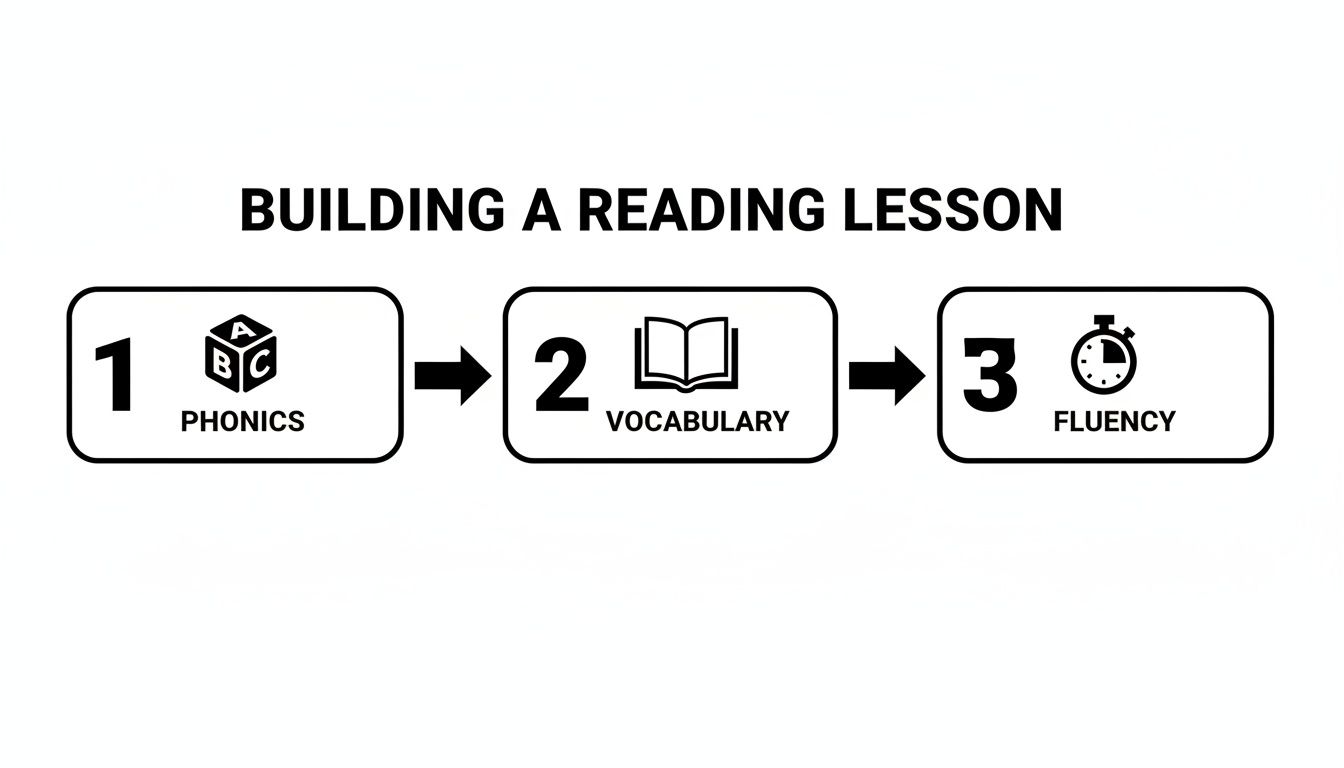
This flow is critical. You start with phonics (the sounds), build up to vocabulary (the meaning), and tie it all together with fluency (the smooth expression). Skipping ahead is like trying to build a house without a foundation, it just won’t hold up.
Sample Lesson Plan Structures for First Grade Reading
To get you started, here are two sample templates, one for a quick 30-minute power session and another for a more in-depth 45-minute lesson. These aren't set in stone, but they provide a balanced structure that ensures you hit all the key components of reading instruction in an engaging way.
| Activity Segment | 30-Minute Session | 45-Minute Session |
|---|---|---|
| Warm-Up & Review | 3–5 minutes: Quick phonemic awareness game or letter sound review. | 5 minutes: Review previous lesson's win and warm up with a familiar activity. |
| Phonics & Word Work | 10–12 minutes: Targeted skill practice (e.g., CVC words, digraphs). | 10 minutes: Focused work on new phonics patterns using multi-sensory games. |
| Vocabulary & Sight Words | Integrated into reading | 10 minutes: Introduce 1-2 new sight words and discuss new vocabulary from the text. |
| Guided Reading & Fluency | 10 minutes: Read a decodable book together, focusing on the target skill. | 15 minutes: Read a passage using techniques like echo reading or repeated reading. |
| Cool-Down & Wrap-Up | 2–3 minutes: End with praise and read a fun, short poem to the student. | 5 minutes: Read a chapter from a high-interest book and give positive feedback. |
Feel free to mix and match activities based on your student’s needs. If they’re struggling with phonics, spend more time there. If their fluency is choppy, dedicate more of the session to guided reading.
The 30-Minute Power Session
Don’t underestimate the power of short, focused sessions. A Stanford study revealed that high-frequency tutoring bursts of just 5–7 minutes a day dramatically improved early literacy. In the study, the number of at-risk students fell by 9 percentage points, proving consistency often beats duration.
Here’s one way to structure a quick but mighty 30-minute lesson:
- Warm-Up (3–5 minutes): Get their brain buzzing with a fast-paced rhyming game ("Tell me three words that rhyme with 'cat'!") or a quick-fire review of letter sounds with flashcards. Keep it light and fun.
- Targeted Skill Work (10–12 minutes): This is where you zoom in. Pick one skill you identified in your assessment. If it’s decoding CVC words, use magnetic letters to build mat, sat, pat. If it's sight words, play a matching game with the words the, a, and I.
- Guided Reading (10 minutes): Time to apply the skill. Choose a decodable reader that’s packed with the phonics pattern you just practiced. You read a sentence, then they echo-read it back. Point to the words as you go.
- Cool-Down (2–3 minutes): Always end on a high note. Read a silly, short poem aloud to them or offer specific praise: "I was so impressed with how you sounded out the word 'ship' today!"
The Expanded 45-Minute Deep Dive
With a longer session, you can give each reading component more breathing room and introduce more variety. This format is ideal for students who can sustain focus a bit longer or who need extra reinforcement on multiple skills. To build out these plans further, check out our guide on how to create a tutoring curriculum framework.
The secret to a longer session is mixing up the activities. A first grader's attention span is a precious, fleeting resource. Switching from a hands-on game with letter tiles to a quiet listening activity can completely reset their focus.
Here’s a sample flow for a 45-minute lesson:
- Warm-Up & Review (5 minutes): Start with a familiar warm-up, but add a quick look back at the last session’s success. "Remember how you mastered the word 'and' last time? Let's see how many times we can find it in this book!"
- Phonics Fun (10 minutes): Dedicate a solid block to sound work. Use word ladders (cat -> bat -> bag -> bug), sound-tapping exercises (tapping out the sounds in "ch-i-p"), or other hands-on, multi-sensory games.
- Sight Words & Vocabulary (10 minutes): Introduce 1-2 new sight words and play a quick game to review old ones. When you hit a new vocabulary word in a story, like "enormous", stop and act it out. Make it memorable.
- Guided Reading & Fluency (15 minutes): This is your main event. Use techniques like repeated reading, where the student reads the same short, simple paragraph 2-3 times to build speed and accuracy. Afterward, ask a simple "who" or "what" question to check for understanding.
- Cool-Down Story Time (5 minutes): Wind down by reading a chapter from a really fun book that’s just above their independent reading level. This exposes them to richer language and, most importantly, reminds them that reading is a magical adventure. It leaves them excited for your next session.
Choosing the Right Tutoring Materials and Resources
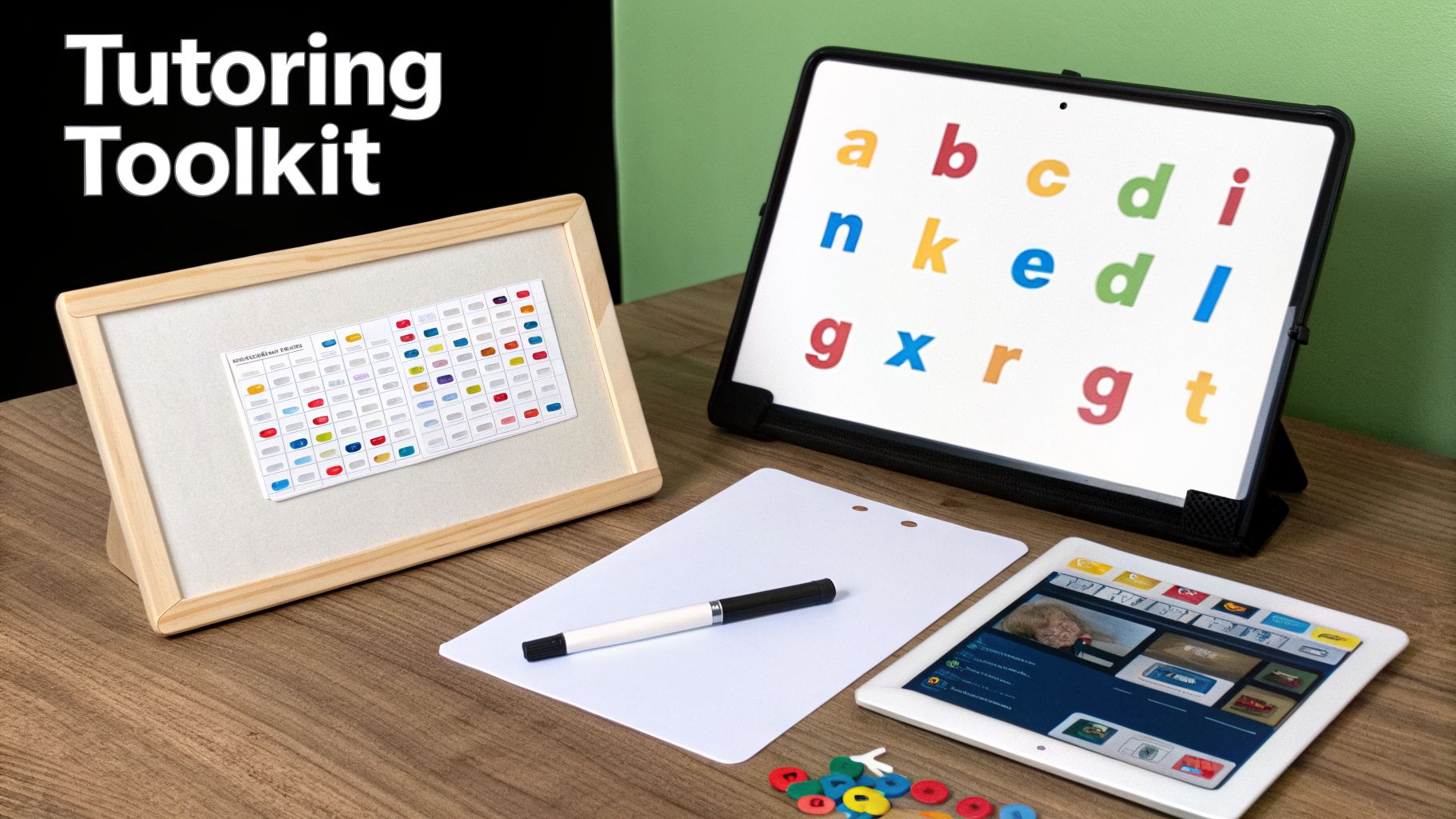
When you’re tutoring a first grader in reading, having a solid toolkit isn't just nice, it's essential. The right materials let you pivot on the spot, reinforce a new skill with a hands-on activity, and keep your sessions from feeling stale. A great kit is a blend of physical tools, digital resources, and the right kind of books.
This doesn't mean you need to break the bank. In our experience, a few smart, low-cost items often deliver the biggest wins. The real goal is to build a versatile and professional tutoring kit so you’re always ready to tackle a tricky concept or celebrate a breakthrough.
Foundational Phonics and Reading Materials
The heart of your toolkit should be materials that make phonics instruction tangible. You're connecting abstract sounds to letters, and for a six-year-old, getting their hands on things makes it all click.
Start with these workhorses:
- Magnetic Letters and a Small Whiteboard: This duo is a powerhouse for word-building. Have students physically move the letters to make words, swap sounds to create word ladders (like cat → hat → hot), or practice spelling tricky sight words.
- Dry Erase Markers and Erasers: Perfect for quickly sounding out words, practicing letter formation, or playing a quick round of hangman with a focus word.
- Index Cards: Incredibly versatile. Use them to create your own flashcards for sight words, letter-sound pairs, or word families (like -at, -in, -op).
These simple tools are fantastic for multi-sensory learning. When a child engages touch and movement along with sight and sound, you're helping them build stronger neural pathways for reading.
Selecting the Right Kind of Books
When tutoring a first grader, not just any book will do. While we all love classic storybooks for read-alouds, your secret weapon for direct instruction is decodable readers. They are an absolute non-negotiable.
Decodable texts are books intentionally written with a high percentage of words that use the phonics patterns a child has already been taught. This gives them immediate opportunities to apply their new skills and experience success, which is a massive confidence booster.
If you hand a first grader a standard storybook, it's often packed with words they simply can't decode yet. That leads to guessing and frustration. Decodable books, on the other hand, build a bridge between learning a phonics rule and actually using it to read a story.
Integrating Digital Tools and Apps
Digital resources can add a really fun, modern layer to your sessions. They're especially clutch for virtual tutoring, a method that's proven incredibly effective. In fact, one 2026 study found the percentage of first graders hitting reading benchmarks jumped from just 6% to 48% after a year of one-on-one virtual sessions. You can learn more about how tutoring boosts early reading outcomes in the full study.
Consider adding a few of these digital options to your kit:
- Educational Apps: Programs like Starfall and ABCmouse offer game-like lessons covering everything from letter sounds to simple sentences. They work great for a quick warm-up or as a fun reward at the end of a productive session.
- Online Decodable Libraries: Websites like Flyleaf Publishing offer free access to fantastic, well-structured decodable books. You can easily pull these up on a tablet or share your screen during a virtual lesson.
- Phonics Game Websites: There are tons of free sites with interactive games that focus on blending sounds, finding rhymes, and practicing word families.
By mixing tangible tools like magnetic letters with targeted decodable books and engaging apps, you create a rich, flexible learning environment. This variety keeps your sessions fresh and ensures you have multiple ways to teach and reinforce every skill your first-grade student needs to become a confident reader.
Tracking Progress and Communicating with Parents
Great tutoring isn’t just about what happens during the lesson. It’s also about demonstrating real, tangible results. Clear progress tracking and strong parent communication are what separate good tutors from truly great ones, it’s what proves your value and turns one-time clients into long-term partners.
The secret is to show, not just tell. A simple system for documenting a student’s growth after each session is your most powerful tool. This doesn't need to be some complex, time-consuming process. A quick, professional weekly email can do wonders for building trust and reinforcing your expertise.
Structuring Your Weekly Parent Updates
The goal of your parent update is to be brief, insightful, and actionable. Parents are busy, so a scannable format is your best friend. A consistent email structure gives them a clear snapshot of their child's journey.
We've found a simple three-part update works best:
- What We Covered: Get specific. Instead of saying "we worked on phonics," try, "Today, we focused on decoding words with the 'sh' digraph, like 'ship' and 'shut'." This shows you have a plan.
- The Big Win: Highlight one moment of success, no matter how small it seems. This builds positive momentum. For example, "Leo had a fantastic breakthrough today! He read a full sentence from his decodable book without any help."
- One At-Home Activity: Give parents a single, easy activity to reinforce the lesson. This makes them part of the team. Something like, "This week, try playing 'I Spy' with things around the house that start with the 'sh' sound."
This kind of structured communication transforms your service from a simple lesson into a collaborative partnership. It shows parents their investment is delivering measurable improvements. If you want to dig deeper into tracking, we have a complete guide on how to track student progress effectively.
Proving Long-Term Impact
Communicating progress isn't just about the weekly wins; it’s about illustrating the long-term value of your tutoring. Early reading intervention has a profound and lasting effect, and highlighting this can be a powerful way to show parents why sticking with tutoring matters.
For instance, a key finding showed that 85% of first graders who reached reading proficiency through tutoring were still on grade level a year later without extra help. This contrasts sharply with just 12% of their peers who didn't get that support.
This is a critical selling point. It frames tutoring not as a temporary fix but as a foundational investment in a child's academic future. You can discover more about these long-term benefits in the EdWeek analysis.
Packaging Services for Tutoring Centers
For tutoring centers, consistent communication and proven results are the bedrock of customer retention. When you systemize your progress reports and parent updates, you demonstrate a level of professionalism that justifies premium services and builds loyalty. This is also where smart service packaging comes into play.
Instead of just offering single, pay-as-you-go sessions, think about creating packages that encourage commitment and improve your cash flow.
Effective Service Packages to Consider:
- Trial Lessons: Offer a one-time free or discounted trial. This lowers the barrier to entry for new parents and gives them a chance to see your value firsthand. An automated system that seamlessly converts a trial to a regular student saves a ton of administrative time.
- Prepaid Credit Packages: Sell lesson bundles (e.g., 10, 20, or 40 lessons) at a slight discount. This model secures revenue upfront and has been shown to dramatically increase client retention. For tutoring centers, this can boost monthly renewals by up to 42%.
- Subscription Models: For the most predictable revenue, offer a monthly subscription for a set number of sessions per week. This model is perfect for parents who understand that reading improvement is a marathon, not a sprint.
By combining systematic progress reporting with strategic service packaging, you create a powerful engine for growth. You not only deliver exceptional results when tutoring a first grader in reading, but you also build a sustainable and professional business that keeps parents invested in their child’s success, and in your center.
Common Questions About First Grade Reading Tutoring
Once you start tutoring a first grader in reading, you’ll quickly find that certain questions and challenges pop up again and again. Whether you’re a solo tutor or running a busy center, having solid, go-to answers is crucial for keeping lessons on track and showing parents the value you provide.
Let's walk through some of the most common hurdles you'll face and give you practical, experience-backed advice for handling them like a pro.
How Often Should I Tutor a First Grader?
When it comes to tutoring a six-year-old, consistency beats session length every time. Forget marathon sessions. The research, and our own experience, points to shorter, more frequent meetings.
An ideal schedule is two to three sessions per week, each lasting about 30–45 minutes. This rhythm helps prevent kids from forgetting what they learned last time and keeps the momentum going. If you're working with a child who has a tough time staying focused, three 30-minute sessions will almost always be more effective than two 45-minute ones.
A study from the Fast Track Project found that first graders who got three 30-minute tutoring sessions a week made significant gains in their reading scores. Consistent practice just works, it solidifies new skills and builds confidence much faster than longer, less frequent lessons.
What Should I Do If the Child Gets Frustrated?
Frustration is a totally normal part of learning, especially when you’re a little kid tackling a big skill like reading. The secret is to have your response planned before it happens. When you see the signs, the wiggling, the big sighs, the glazed-over eyes, that’s your cue to pivot. Immediately.
Don’t try to power through. Instead, switch to something you know they can do successfully. This could be a quick word game, rereading a book they love, or even just a 60-second “brain break” to stand up and stretch. Your number one job in that moment is to help them feel successful again.
After the session, make a quick note of what triggered the frustration. Was the text too challenging? Was the activity too long? That’s gold-standard data for tweaking your next lesson plan to make sure it’s a better fit.
How Do I Choose the Right Books?
Picking the right book is one of the most important decisions you'll make in a session, and the "right" book depends entirely on what you're trying to accomplish.
- For Skill Practice (Guided Reading): You absolutely need to use decodable readers. These books are engineered with words that only use the phonics patterns the child has already been taught. It gives them a real shot at applying what they’ve learned and feeling that "I can do it!" moment, which is a huge confidence-builder.
- For Building Vocabulary and Love of Reading (Read-Alouds): This is where you bring out the good stuff. Choose high-interest, beautiful storybooks that are actually a little above their independent reading level. When you read aloud, you expose them to richer language and more complex stories in a completely low-pressure environment.
Never, ever use a regular storybook for guided reading practice with a struggling first grader. It almost always encourages guessing and reinforces the exact habits you’re trying to break. The goal of practice is success, and decodable books are built for that.
Should I Correct Every Mistake?
No. Constant interruptions to point out every little error will kill a child’s confidence and destroy their reading flow. You have to be strategic with your feedback.
During a first read-through of a new text, the main goal is for the child to build some momentum and feel like a reader. Only jump in if they make a mistake that completely changes the meaning of the sentence.
On a second or third read (like when you’re doing fluency work), you can be more direct. Point to the word they stumbled on and say something like, "Let's take another look at this word. What sound does this letter make?" This reframes the correction as a quick, focused teaching moment instead of a constant critique.
Managing these details for every student can be complex. Tutorbase streamlines your operations by helping you track student progress, manage custom curriculum details like reading levels, and package your services with prepaid credits or trial lessons. This frees you up to focus on what matters: delivering outstanding reading instruction. Simplify your admin and grow your tutoring business by getting started at tutorbase.com/register.


