


Teachable is a powerful platform for creating and selling online courses, but it was designed primarily for individual creators selling pre-recorded content. Tutoring centers, language schools, and test prep academies have fundamentally different needs. Your business isn't just about content delivery; it's about managing complex operations involving people, places, and payments. You juggle multi-teacher schedules, variable student attendance, complex payroll calculations, and room bookings across multiple locations. Using a tool built for a different business model often leads to a messy patchwork of spreadsheets and calendars.
This administrative burden is precisely the problem we aim to solve. This guide details the top 10 alternatives to Teachable for tutors, moving beyond simple course hosting to focus on platforms built for service-based educational businesses. We will analyze each option through the specific lens of a tutoring operator, focusing on critical features like automated scheduling, integrated billing, multi-location management, and teacher payroll.
Inside this resource, you will find a comprehensive breakdown of each platform, complete with:
- Real-world use cases for tutoring centers.
- Honest pros and cons based on operational needs.
- Direct links and up-to-date screenshots.
- A detailed feature comparison table.
Our goal is to help you move from administrative chaos to a streamlined, automated system. By the end of this article, you will have a clear understanding of which platform can best support your growing tutoring business, reduce your admin time by up to 60%, and help you scale effectively.
1. Tutorbase
Tutorbase is not just another course platform; it's an AI-powered tutoring management system designed to serve as the central nervous system for growing tutoring centers. While Teachable excels at one-to-many course delivery, Tutorbase is engineered to solve the complex operational challenges of high-volume, multi-teacher, and multi-location tutoring businesses. It replaces fragmented tools like Google Calendar, QuickBooks, and Excel with a single, unified dashboard.
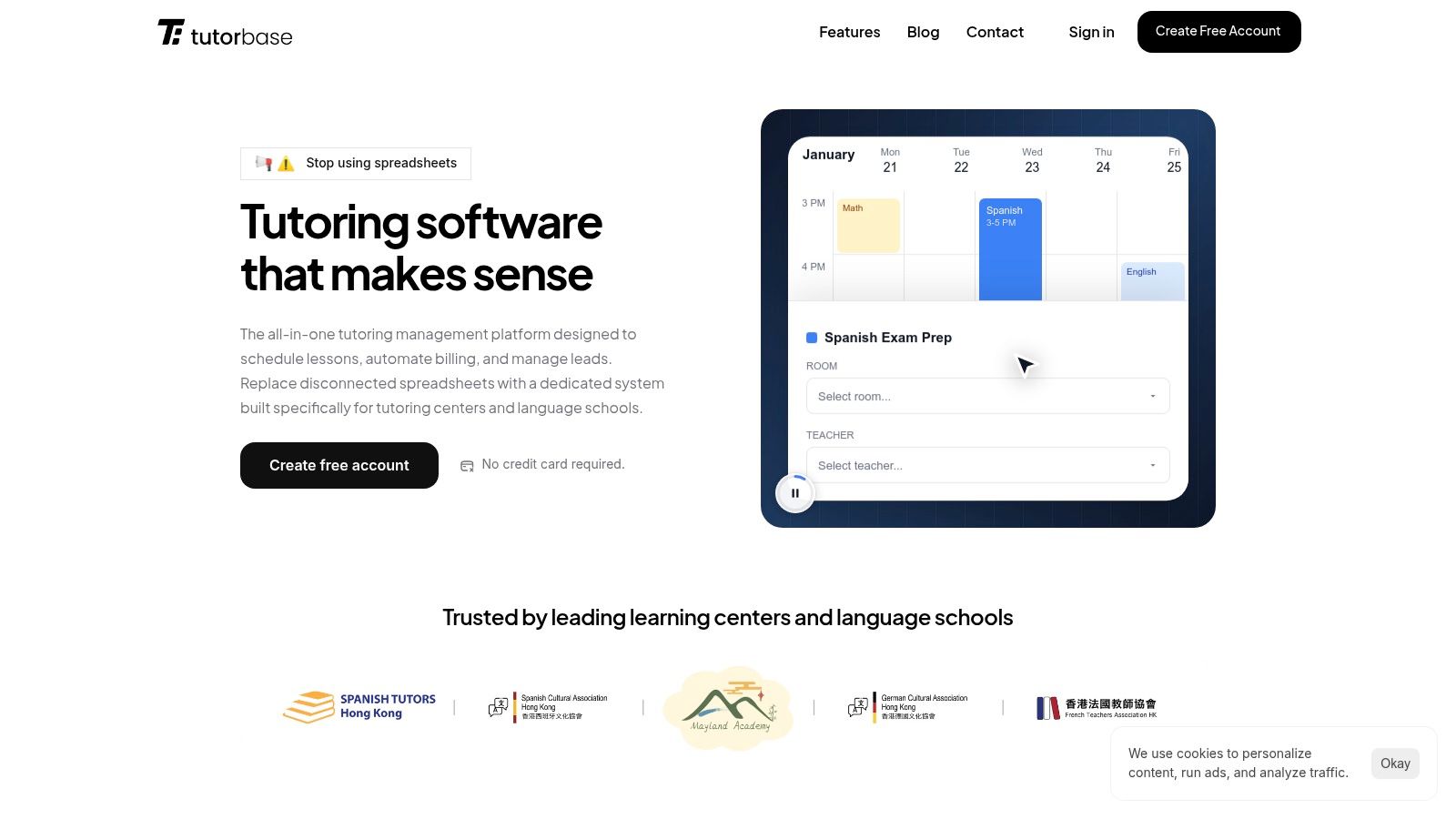
Its standout features are built around intelligent automation. The AI-driven scheduling tools, "Find Slot" and "Find Spot," eliminate double-bookings by instantly matching available teachers, rooms, and student needs. This reduces booking time from 10 minutes to under 2 minutes and maximizes resource utilization. Billing is directly tied to attendance, automatically generating invoices from completed lessons and managing everything from prepaid credit packages to complex subscriptions. This operational focus makes it one of the most powerful top 10 alternatives to Teachable for tutors who are scaling their business.
Key Features and Use Cases
- Intelligent Scheduling: Use "Find Slot" to instantly generate valid time, teacher, and room options for a new student, cutting booking time from minutes to seconds. "Find Spot" helps fill empty seats in existing group classes to maximize revenue.
- Automated Billing & Payroll: Connect lesson attendance directly to invoicing. The system supports prepaid credits, packages, and subscriptions, while the payroll engine handles complex models like revenue-sharing and overtime, ensuring accurate and timely payments.
- Multi-Branch Management: Oversee multiple locations from a single dashboard. Track room availability and fees, manage staff across branches, and apply location-specific pricing or cancellation policies.
- Integrated CRM: Capture leads through a WhatsApp widget or embeddable website forms. Manage the entire student lifecycle from initial inquiry to conversion without leaving the platform.
Pros and Cons
Pros:
- All-in-one Automation: Consolidates scheduling, billing, and payroll, reducing administrative time by up to 60%.
- Built for Scale: Designed to handle the complexity of multi-branch centers with 10,000+ lessons per week.
- Advanced Financial Tools: Offers flexible, attendance-driven billing and sophisticated payroll models that basic platforms lack.
- Zero Double-Bookings: AI-powered conflict detection provides reliability for complex schedules.
Cons:
- No Public Pricing: Requires contacting the sales team for a tailored quote, which can be a hurdle for those wanting quick price comparisons.
- Potential Overkill for Solo Tutors: The platform's depth and extensive features might present a steeper learning curve for individual tutors with simple needs.
Tutorbase is the definitive choice for established tutoring centers, language schools, and test-prep academies aiming to systematize operations and unlock growth. You can compare Tutorbase with other tuition management systems in this detailed review.
Website: https://tutorbase.com
2. Thinkific
Thinkific positions itself as a robust, all-in-one platform for knowledge entrepreneurs, making it a strong alternative to Teachable for tutors scaling their business. It excels where tutors need to package their expertise into structured courses, build learning communities, or sell digital products alongside their live sessions. For tutoring centers, its support for bulk seat sales and corporate training features are particularly valuable.
Unlike platforms focused solely on one-on-one scheduling, Thinkific is built for creating scalable educational assets. A test prep center, for example, can create a comprehensive SAT course with video lessons, quizzes, and assignments, then sell access to it on a subscription basis or as a one-time purchase. The platform's direct Zoom integration facilitates live group classes, while its community feature allows for ongoing student interaction and support outside of scheduled lesson times. This makes it a great fit for businesses that offer a blend of self-paced learning and live instruction.
Key Strengths and Use Cases
- B2B and Group Sales: The ability to sell course enrollments in bulk with group invoicing is a key differentiator. This is ideal for tutoring centers that partner with schools or companies.
- Structured Learning Paths: Tutors can create comprehensive curricula with prerequisites and completion certificates, which is excellent for language schools or any level-based program.
- Flexible Product Offerings: You can sell standalone courses, memberships that grant access to all content, or bundles of courses and digital downloads.
Pricing and Limitations
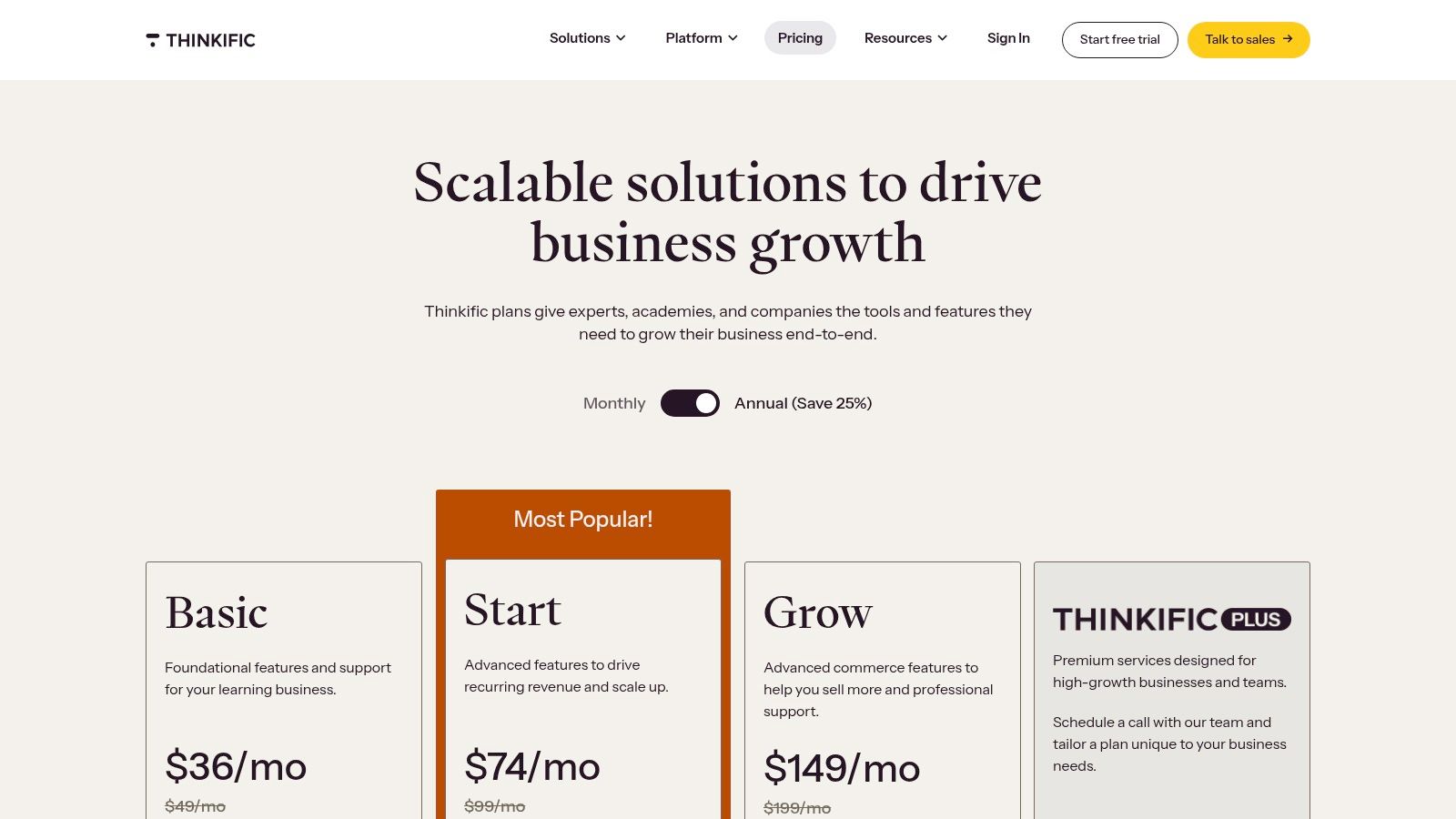
Thinkific offers a free plan to get started, with paid plans ranging from approximately $36/month to $149/month when billed annually. Higher-tier plans unlock advanced features like API access and bulk enrollment. A key consideration is that while Thinkific Payments has zero transaction fees, using third-party gateways like Stripe or PayPal will incur their standard processing fees. As you explore various platforms, you can learn more about how Thinkific fits into the broader LMS software landscape on tutorbase.com.
Website: https://www.thinkific.com/pricing/
3. Kajabi
Kajabi is a premium, all-in-one platform designed for serious knowledge entrepreneurs who want to unify their marketing, sales, and content delivery systems. It serves as a powerful Teachable alternative for established tutors and tutoring businesses aiming to build a sophisticated brand ecosystem. Instead of just hosting courses, Kajabi provides integrated tools for building sales funnels, running email marketing campaigns, creating websites, and managing a full suite of digital products.
This integrated approach is where Kajabi shines. A test prep business, for example, can use it to create lead-capture landing pages, nurture prospects with automated email sequences, sell a high-ticket course, and then deliver that course content alongside a members-only community. Its native CRM-lite features and marketing automations allow tutors to build a cohesive student journey from first contact to final exam, all without piecing together multiple third-party tools. For those scaling their operations, this consolidation is a significant advantage.
Key Strengths and Use Cases
- Integrated Marketing Suite: The platform includes native email marketing, landing page builders, and sales funnels, eliminating the need for separate subscriptions to services like Mailchimp or Leadpages.
- Advanced Automation: Tutors can create "if-then" automations based on student behavior, such as granting access to a bonus module after a quiz completion or sending a follow-up email after a video is watched.
- Multiple Product Types: Beyond courses, Kajabi supports podcasts, coaching programs, and membership communities, allowing tutors to diversify their revenue streams under one brand.
Pricing and Limitations
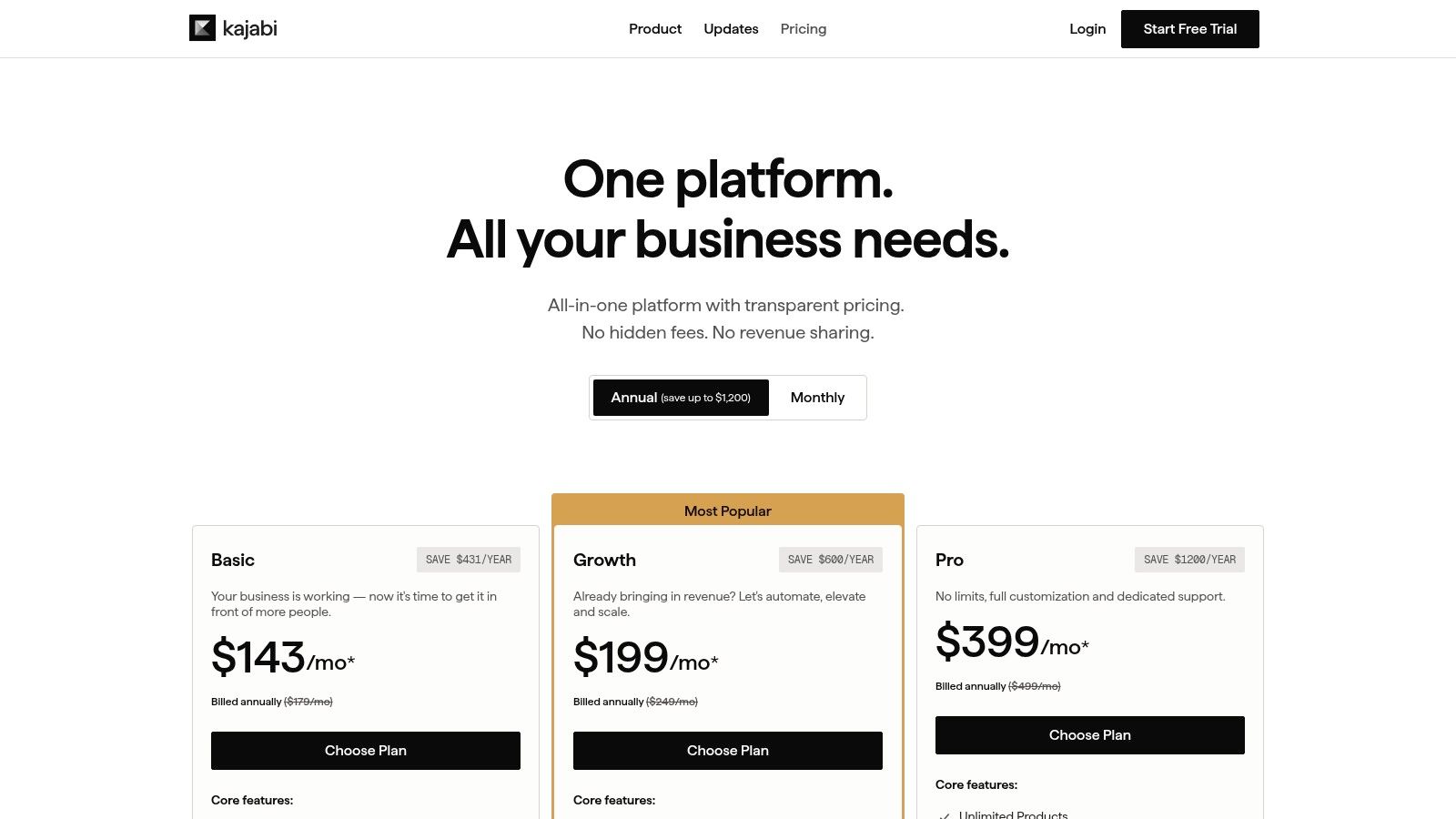
Kajabi’s pricing reflects its all-in-one nature, with plans starting at approximately $119/month when billed annually. Higher-tier plans add more products, pipelines, and admin users. While Kajabi Payments has no transaction fees, using Stripe or PayPal will incur their standard fees plus an additional percentage fee on some plans. The higher price point makes it a better fit for tutors with an established business model. As you grow, it's crucial to have a solid framework, which you can refine by creating a comprehensive tutoring business plan on tutorbase.com.
Website: https://www.kajabi.com/pricing
4. Podia
Podia is a creator-friendly platform designed for simplicity, making it a strong alternative to Teachable for solo tutors or small businesses who want to sell courses, memberships, and digital downloads without technical overhead. It combines a website builder, course platform, and email marketing tools into one clean interface, reducing the need for multiple subscriptions. Its main appeal lies in its speed-to-market and all-in-one nature.
For a tutor looking to quickly package their expertise, Podia is exceptionally efficient. A language tutor could, for instance, create a "Beginner Spanish" course, a monthly "Conversation Club" membership, and sell a PDF e-book of vocabulary flashcards, all from a single dashboard. The built-in email marketing allows them to nurture leads and announce new products without needing a separate tool like Mailchimp. This integrated approach is perfect for individuals who prioritize ease of use over complex, enterprise-level administrative features.
Key Strengths and Use Cases
- All-in-One Simplicity: Combines storefront, website, products, and email marketing. This is ideal for solo tutors who want to manage everything in one place and minimize their software stack.
- Unlimited Products: You can create and sell as many courses, downloads, and coaching sessions as you want on any paid plan, offering great scalability for content creation.
- Integrated Community: A built-in community feature allows you to create free or paid groups for your students, fostering engagement directly on the platform.
Pricing and Limitations
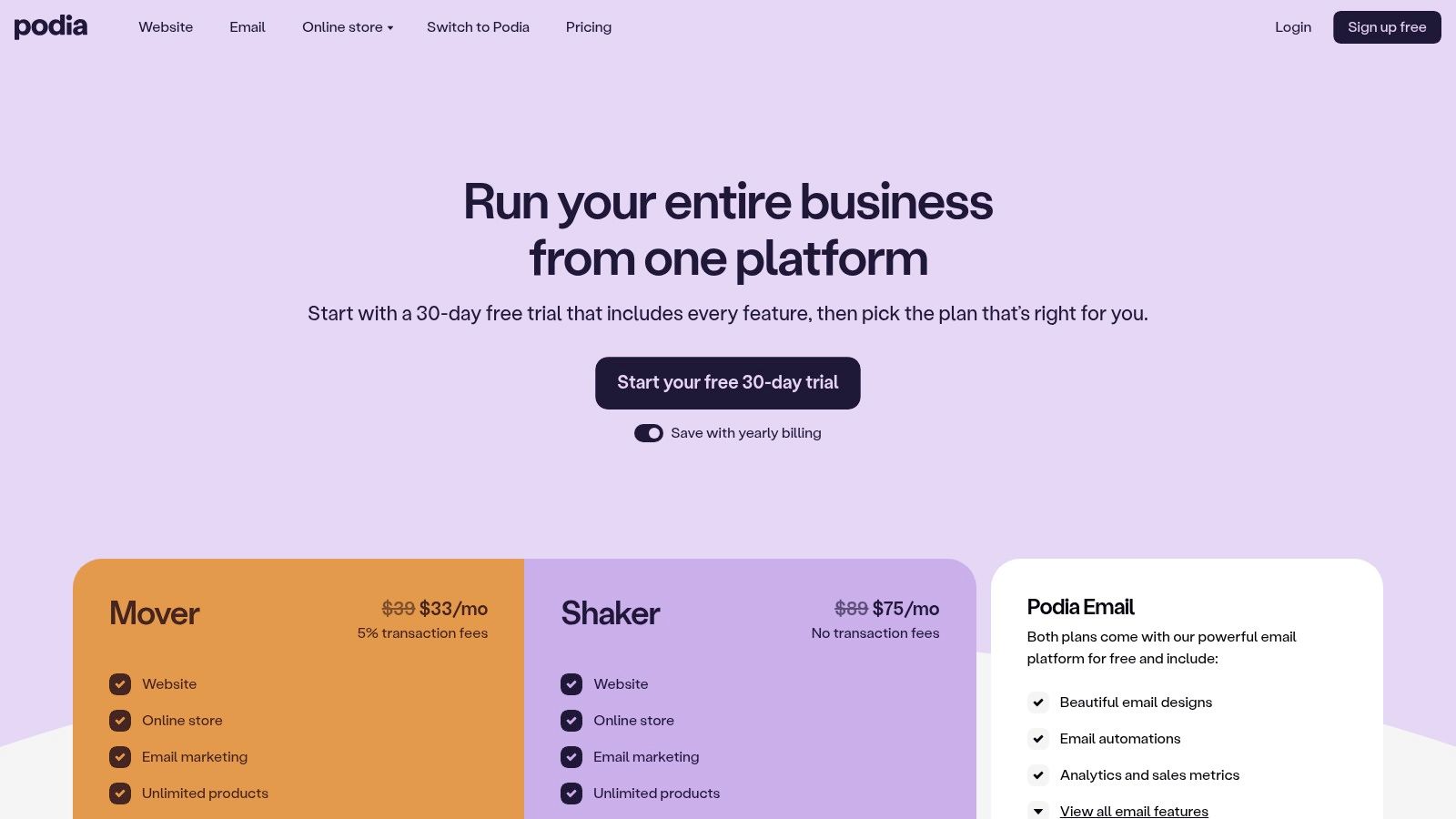
Podia offers a free plan with an 8% transaction fee. Paid plans start at around $33/month (billed annually) and remove transaction fees, offering more features like custom domains and affiliate marketing. A key limitation is its lack of advanced administrative controls for larger tutoring centers, such as complex payroll, multi-teacher scheduling, or detailed reporting. It is best suited for the "solopreneur" tutor rather than a multi-branch school.
Website: https://www.podia.com/pricing
5. LearnWorlds
LearnWorlds carves out a niche as a powerful alternative to Teachable for tutors focused on creating highly interactive and pedagogically sound learning experiences. It is particularly well-suited for test-prep academies, language schools, and professional training providers who need robust assessment tools. The platform excels in transforming passive video content into active learning modules, making it a strong choice for outcome-driven programs.
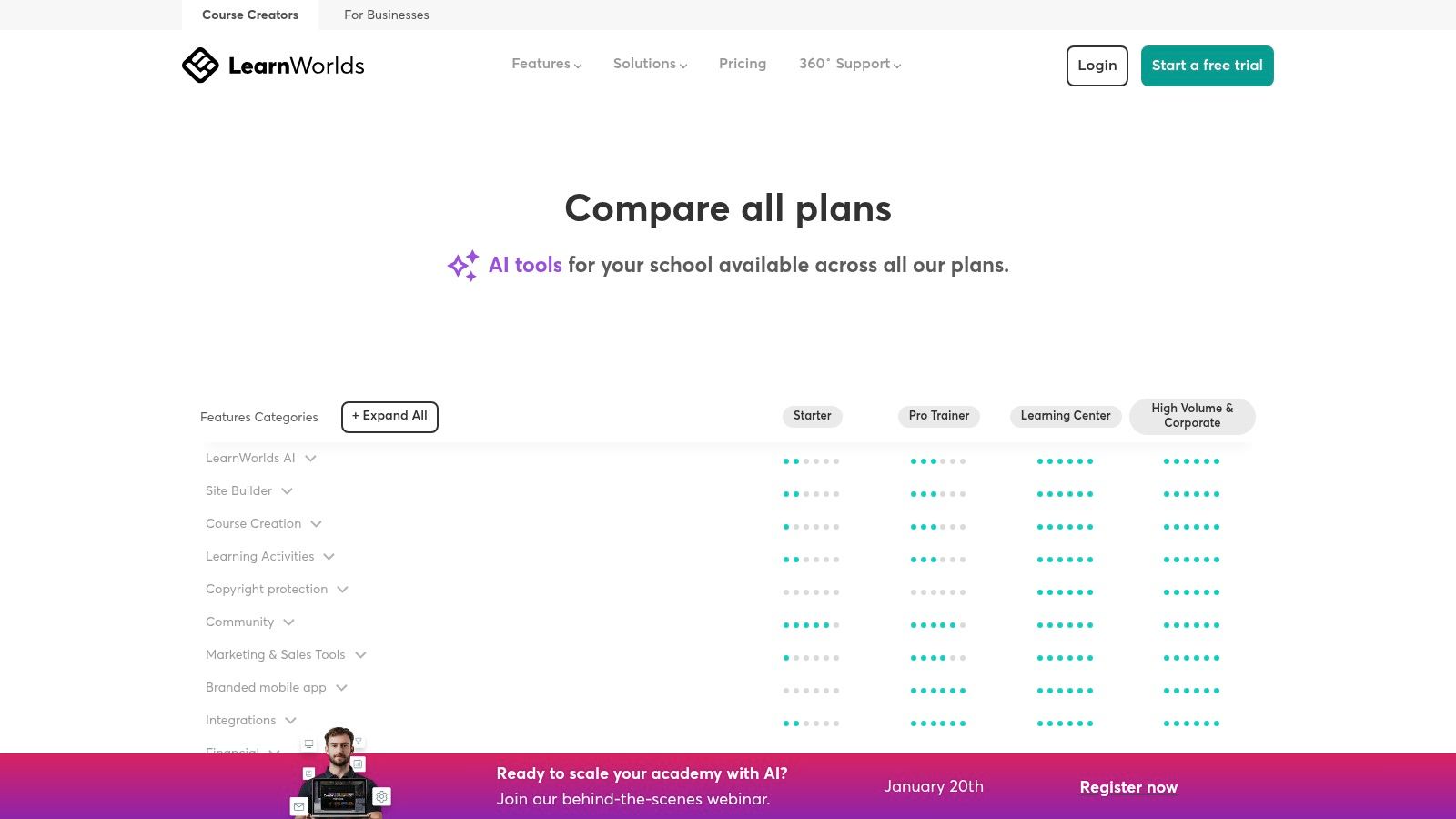
Unlike simpler course platforms, LearnWorlds is built for deep engagement. An IELTS preparation center, for instance, can use the interactive video editor to embed questions directly into lesson footage, ensuring students comprehend key concepts before moving on. The platform's advanced assessment engine allows for creating graded quizzes, formal exams, and assignments, complete with certificates upon completion. This focus on structured, measurable learning makes it ideal for tutors whose students need to demonstrate proficiency and achieve specific qualifications.
Key Strengths and Use Cases
- Interactive Learning Tools: Features like interactive video, note-taking, and AI-generated subtitles create a more engaging and accessible learning environment than standard video lectures.
- Advanced Assessments and Certifications: Tutors can build sophisticated quizzes, exams, and assignments, making it perfect for formal test preparation and skill-based training.
- B2B and Group Sales: Higher-tier plans support seat sales and user groups, enabling tutoring centers to easily manage corporate training clients or school partnerships.
Pricing and Limitations
LearnWorlds offers a 30-day free trial, with paid plans starting at approximately $24/month (billed annually), which includes a $5 fee per course sale. Higher-tier plans, which unlock SCORM compliance and B2B features, range from $79/month to $249/month. A significant limitation is that recurring payments and subscriptions require Stripe integration. While rich in features, accessing the most powerful tools for group sales and formal eLearning standards requires a commitment to the more expensive Learning Center plan.
Website: https://www.learnworlds.com/plans/
6. LearnDash
For tutoring businesses built on WordPress, LearnDash is a leading alternative to Teachable, transforming a standard website into a powerful Learning Management System (LMS). It's ideal for tutors and centers who prioritize full control, data ownership, and the ability to customize every aspect of the student experience. Rather than a hosted platform, it's a plugin that gives you complete command over your courses, branding, and monetization within your own WordPress environment.
Unlike all-in-one SaaS platforms, LearnDash leverages the vast WordPress ecosystem. A language school, for instance, can use LearnDash for its core curriculum and then integrate specialized plugins for booking appointments, managing memberships, or running an e-commerce store with WooCommerce. This modular approach is perfect for established businesses with specific technical requirements or those wanting to avoid platform-based transaction fees. For those less comfortable with self-hosting, the "LearnDash Cloud" option provides a pre-configured WordPress site, offering a middle ground between total control and ease of use.
Key Strengths and Use Cases
- Full Ownership and Customization: You own your data and content, with endless customization possibilities through WordPress themes and thousands of plugins.
- Advanced Quizzing and Assignments: Features like graded assignments, quiz timers, and detailed reporting are excellent for test prep academies and formal education programs.
- Cost-Effective for Large Catalogs: A single annual license allows you to create unlimited courses and enroll unlimited students, making it economical as your business scales.
Pricing and Limitations
LearnDash is sold as an annual plugin license, starting around $199/year. This price does not include WordPress hosting, themes, or other premium plugins you may need for e-commerce or advanced scheduling. The total cost of ownership can vary significantly depending on your hosting provider and the additional plugins you purchase. The main limitation is the technical overhead. Managing updates, security, and plugin compatibility requires a degree of WordPress administration, which may be a hurdle for less tech-savvy tutors.
Website: https://www.learndash.com/
7. Mighty Networks
Mighty Networks presents a compelling community-first alternative to Teachable, ideal for tutors who want to build a loyal following around their teaching. It shifts the focus from standalone courses to an integrated ecosystem where learning happens through courses, live events, group chats, and member interaction. For tutors running cohort-based programs or accountability groups, this platform provides the tools to foster engagement and peer-to-peer support that traditional course platforms lack.
Instead of just selling a course, a language tutor could use Mighty Networks to create a "Spanish Fluency Club." This club could include a self-paced grammar course, weekly live practice sessions via the platform's streaming feature, and dedicated chat groups for students to practice with each other. This model turns a one-time transaction into a recurring membership, building a sustainable business while delivering continuous value. The platform’s native iOS and Android apps also ensure students can engage with the community and content from anywhere.
Key Strengths and Use Cases
- Live Cohort Courses: Excellent for time-based programs where a group of students progresses together, supported by livestreams, events, and dedicated discussion spaces.
- Membership Communities: Ideal for creating recurring revenue by offering continuous access to content, live events, and a network of peers for a monthly or annual fee.
- Blended Learning: Seamlessly combine pre-recorded course materials with live instruction and group interaction, creating a richer, more engaging student experience.
Pricing and Limitations
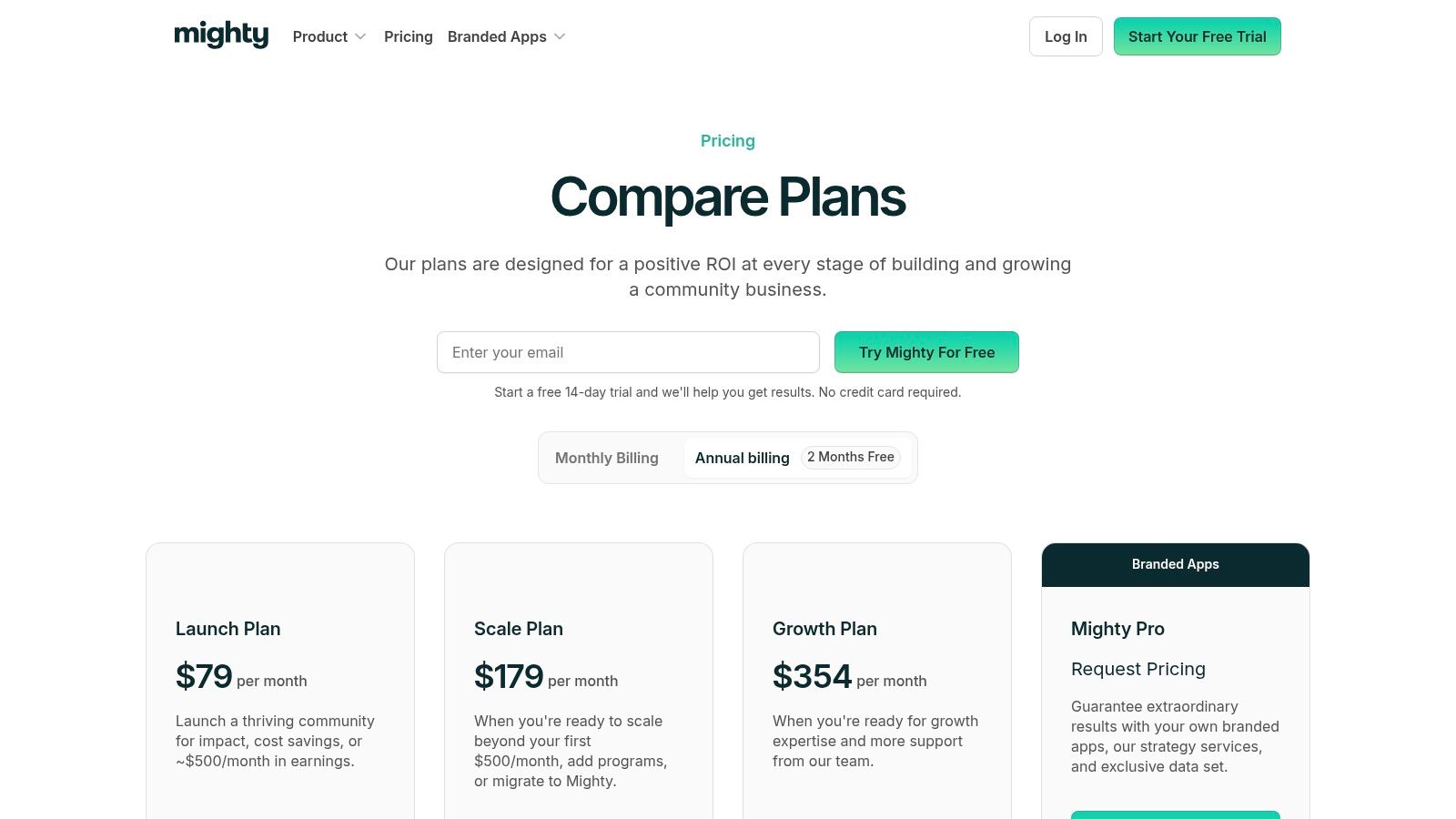
Mighty Networks offers tiered pricing, with the "Community" plan starting around $33/month and the "Business" plan at $99/month when billed annually. A key limitation is that its course authoring tools are simpler compared to specialized LMS platforms like Teachable or Thinkific. It's built for community first, with courses as a feature within that community. For tutors who only need basic course functionality but prioritize student engagement, it's a powerful choice among alternatives to Teachable.
Website: https://www.mightynetworks.com/pricing
8. Payhip
Payhip is an accessible e-commerce platform that serves as a lightweight alternative to Teachable, especially for tutors just starting to sell digital products. It is designed for creators who need a simple, low-cost way to offer courses, memberships, and digital downloads without the complexity of a full-scale Learning Management System (LMS). Its main appeal is the transparent, feature-inclusive pricing model, which removes barriers for budget-conscious educators.
The platform is ideal for a solo tutor who wants to sell a recorded video series of their most popular lessons or offer a monthly subscription for exclusive practice worksheets. Payhip simplifies the entire process from upload to checkout, handling digital delivery and EU/UK VAT compliance automatically. While it lacks the advanced student management and scheduling features of dedicated tutoring software, its strength lies in its simplicity and affordability for selling straightforward educational content.
Key Strengths and Use Cases
- Low-Cost Entry: With a free plan that only charges a transaction fee, tutors can start selling immediately without any upfront investment. This is perfect for testing a new course idea.
- All-in-One Digital Storefront: You can sell video courses, e-books, coaching services, and memberships all from a single, easy-to-manage dashboard.
- Simplified Sales Process: The platform is built for direct-to-consumer sales, making it incredibly easy for a tutor's students to purchase and access materials instantly.
Pricing and Limitations
Payhip offers three plans, all with identical features but with decreasing transaction fees: a Free plan (5% fee), a Plus plan at $29/month (2% fee), and a Pro plan at $99/month (0% fee). Standard Stripe and PayPal processing fees still apply. The primary limitation for a growing tutoring center is its lack of robust "school" features, such as multi-teacher administration, advanced reporting, or integrated live lesson scheduling. It excels as a simple sales tool rather than a comprehensive business management platform.
Website: https://payhip.com/pricing
9. Gumroad
Gumroad offers a straightforward, e-commerce-focused alternative for tutors who want to sell digital products without the complexity of a full learning management system. It's an excellent choice for solo tutors or small businesses looking to monetize supplementary materials like study guides, video tutorials, e-books, or worksheet packs. Instead of building intricate courses, you can quickly create a simple, effective storefront.
The platform’s major appeal is its role as a merchant-of-record. Gumroad handles all payment processing and, crucially, global sales tax and VAT compliance, a significant administrative burden for tutors selling internationally. A French tutor could sell a "DELF B1 Exam Prep Pack" to students worldwide without worrying about calculating and remitting taxes for each country. Its simplicity makes it one of the faster ways to start selling, positioning it as a strong alternative to Teachable for tutors focused on product sales over live instruction.
Key Strengths and Use Cases
- Global Tax Compliance: Gumroad automatically handles sales tax and VAT, which is a huge advantage for tutors with an international student base.
- Simple Product Sales: Perfect for selling one-off digital products like practice exams, video lessons, or curated study resources without needing a complex course builder.
- Membership Tiers: Tutors can offer recurring subscriptions for access to a library of content or a private community, creating a stable income stream.
Pricing and Limitations
Gumroad's pricing is a flat 10% fee per sale, which drops as your lifetime earnings increase. There are no monthly subscription fees, making it free to start. This model is great for those with unpredictable sales volumes but can become costly for high-volume sellers. The platform's main limitation is its lack of advanced LMS features like student progress tracking, quizzing, or direct scheduling integrations. It is a storefront, not a comprehensive tutoring management tool.
Website: https://gumroad.com/pricing
10. Teachery
Teachery offers a refreshingly simple, minimalist approach for tutors who want to create and sell online courses without technical overwhelm. It stands out by stripping away complex features and focusing purely on the course creation experience. This makes it an ideal alternative to Teachable for solo tutors or small businesses that need a straightforward way to package their knowledge into a self-paced format, without getting bogged down in marketing automation or community management tools.
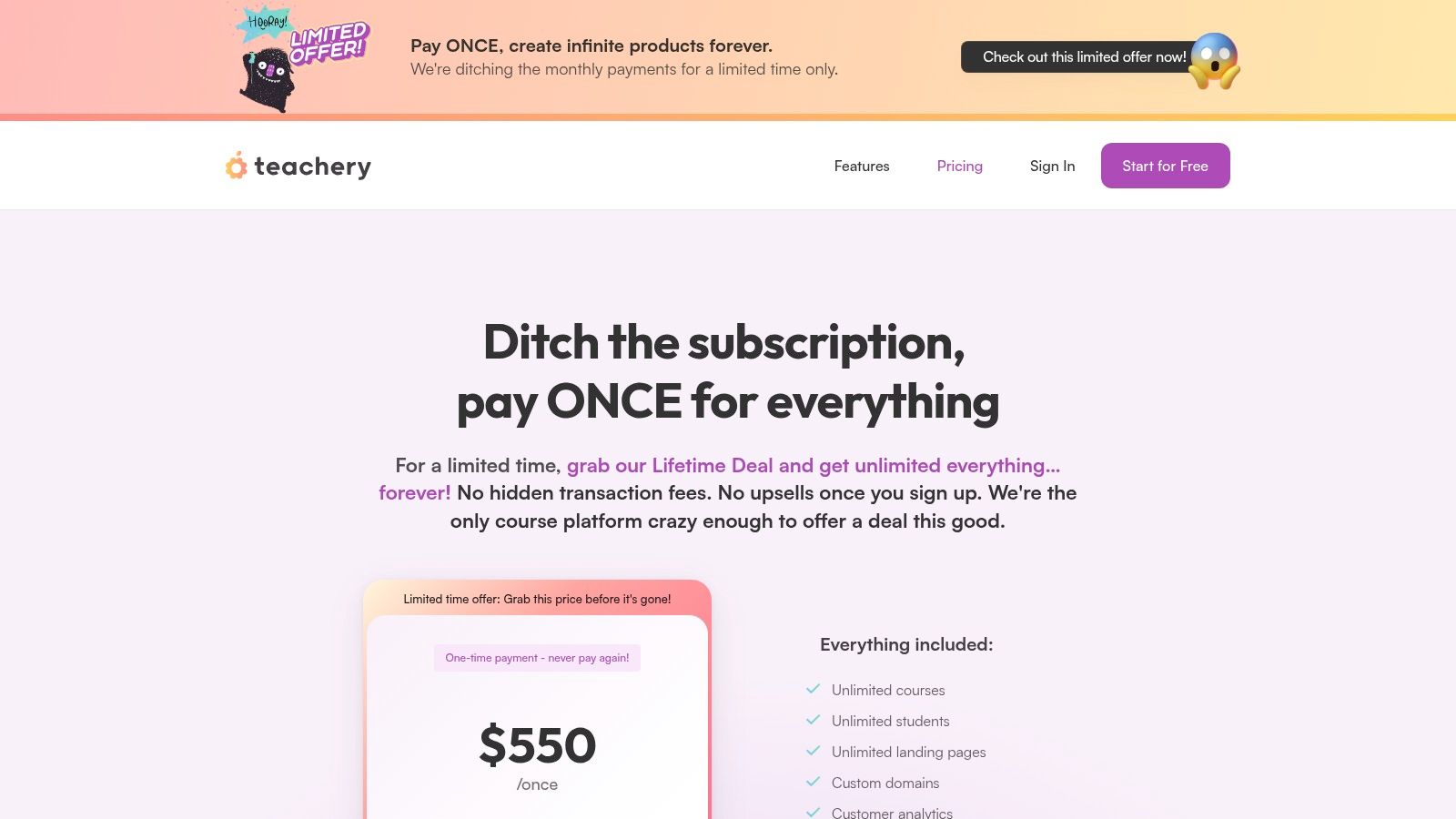
The platform's core philosophy is built on simplicity and transparency. For a flat monthly or annual fee, tutors get unlimited courses, students, and landing pages with zero platform transaction fees. A language tutor, for instance, could create separate courses for beginner, intermediate, and advanced levels, each with its own sales page and drip-fed lessons, all under a single plan. The focus is entirely on delivering the educational content, making it a great choice for tutors who already have an audience and simply need a reliable, no-fuss delivery vehicle for their digital curriculum.
Key Strengths and Use Cases
- Unlimited Everything: Create as many courses and enroll as many students as you need without your pricing plan changing, which is perfect for prolific creators.
- No Transaction Fees: Teachery doesn't take a cut of your sales, a significant advantage over many competitors. You only pay standard Stripe processing fees.
- Extreme Simplicity: The course builder is incredibly intuitive. It's designed for speed and ease of use, allowing you to get a course online in hours, not weeks.
Pricing and Limitations
Teachery offers a straightforward pricing model at a flat rate of approximately $49/month or a one-time lifetime deal. This simplicity is its greatest strength but also its main limitation. It lacks advanced learning management system (LMS) features like complex quizzing, SCORM compliance, or integrated community tools. It is not designed for multi-teacher operations or tutoring centers needing robust scheduling and payroll management. This makes it one of the less comprehensive "top 10 alternatives to Teachable for tutors" if you need an all-in-one business solution.
Website: https://www.teachery.co/pricing
Choosing Your Ideal Tutoring Platform
What is the main difference between Teachable and its alternatives for tutors?
The primary difference is that Teachable is a Learning Management System (LMS) built for selling pre-recorded courses, while many top alternatives are tutoring management software designed to run the daily operations of a service-based tutoring business. Tutors need tools for live scheduling, attendance tracking, automated invoicing, and complex payroll, which Teachable does not provide natively.
What should tutoring centers prioritize when choosing software?
Tutoring centers should prioritize features that solve their biggest administrative problems. Key priorities include intelligent scheduling with conflict detection to avoid double-bookings, automated billing that generates invoices from attendance records, multi-teacher payroll that handles different pay rates, and multi-location management if you operate more than one branch.
How can I decide if I need a simple course platform or a full management system?
If your business primarily sells self-paced video courses and digital downloads with minimal live interaction, a simple platform like Podia or Gumroad is sufficient. If your business model is based on delivering live 1-on-1 or group lessons with multiple teachers, a full management system like Tutorbase is essential to handle the operational complexity and reduce admin time.
Are there any free alternatives to Teachable?
Yes, several platforms offer free-forever plans, though they often come with limitations. Systeme.io provides a generous free plan with marketing tools, while Podia and Payhip offer free plans that charge a higher transaction fee per sale. These are good starting points but may become costly as your revenue grows.
What is the best alternative for a tutoring center with multiple locations?
For multi-location tutoring centers, the best alternative is a platform with robust multi-branch management features. Tutorbase is specifically designed for this, allowing you to manage scheduling, staff, rooms, and location-specific pricing from a single dashboard. TalentLMS also offers "branches" for creating separate, branded portals for each location.
How important is automation in tutoring management software?
Automation is critical for scaling a tutoring business. Automating tasks like invoice creation, payment reminders, and payroll calculations can reduce administrative time by up to 60%. This frees you from manual data entry, reduces human error, and allows you to focus on growth activities like marketing and teacher development.
Can I migrate my existing students and data to a new platform?
Most reputable platforms provide tools or support for data migration. When evaluating options, ask their sales or support team about their process for importing student data, lesson history, and financial records. A smooth migration is key to a successful transition.
Ready to eliminate administrative chaos and focus on teaching? Tutorbase is the AI-powered management software built specifically for tutoring centers that have outgrown generic course platforms. Stop wrestling with spreadsheets and start automating your scheduling, billing, and payroll. Register on Tutorbase to see how you can reduce your admin time by 60%.


